
Everything That Was Already There: On Twenty Years of Making
A profile of Gordana Zikic, interdisciplinary artist, co-founder of Belgrade Artist in Residence and Virtual Studio Groups, based in Barcelona.
Instagram · gordanazikic.wordpress.com
There is a particular quality of attention that takes years to recognise in oneself. Not the concentrated looking of the studio — the deliberate, effortful kind — but the other sort: the looking that happens while you are doing something else, while you are living, while you are simply outside. Gordana Zikic has been making work from that kind of attention for over two decades. Much of it has never been seen online. Some of it is on paper, rolled up against the years. Some of it is on MDF boards, stored with a friend outside Belgrade, surviving time in its own way. What follows is an attempt to bring a selection of it briefly into the light — a glimpse of an archive that goes far beyond what is gathered here.
Zikic — who goes by Gotza — is a Belgrade-born, Barcelona-based interdisciplinary artist working across painting, installation, performance, photography, and ritual objects. She is co-founder of Belgrade Artist in Residence (BAIR) and of Virtual Studio Groups (VSG), both of which she runs with her partner Bosko. She holds a doctorate in Fine Arts from Belgrade, awarded in 2018. In a recent VSG session, she shared work spanning roughly twenty years — from her early student years through the photographic practice she has been building since her arrival in Barcelona, and which she is now looking at with new eyes.
Three Figures, One Year
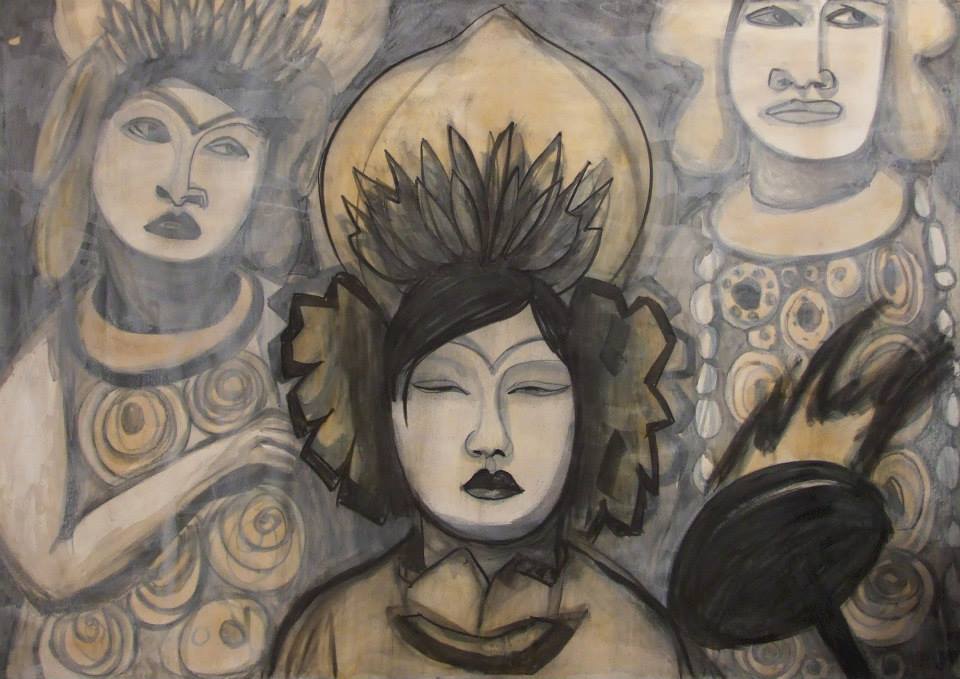
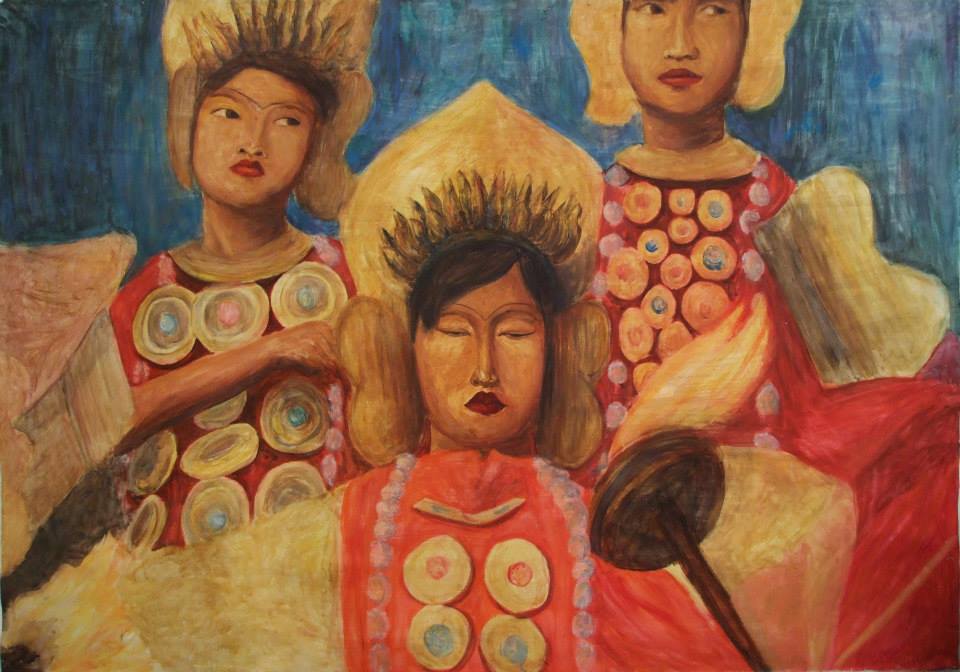
The earliest works she shared were made in 2002 and 2003, during her studies, from a single source: a photograph found in an airplane magazine, showing three girls in festival costume from Nepal. She returned to it again and again across an entire academic year, making around ten works — paintings and drawings on large sheets of paper, around 2 × 1.5 metres — in charcoal, shellac, tempera, and acrylic, sometimes in combination, sometimes alone.
The materials behaved differently from each other and she let them. Charcoal and shellac built up in layers on the brown paper she received in rolls from the school; the shellac, applied over the charcoal, gave a faint golden warmth that she had not planned for and decided to keep and use in the future paintings. Tempera, more transparent than acrylic and softer in its deposits, produced something closer to fresco in the finished surface. Acrylic gave density, opacity, layers you could feel as weight. Each technique produced a different version of the same three figures — and through repetition, the figures slowly changed. "When you do the same motif," she said, "you learn it by heart — and then you have more freedom. At first they were trying to imitate the real. But over time the characters become more abstract, more expressive. You can do one line for a nose, and you know where it should be."
What the works carry, across all their variations, is something that goes beyond technique. The three figures — in charcoal versions rendered in grey-gold tones, eyes closed or cast inward, their ceremonial headdresses translated into mark and gesture; in the coloured tempera and acrylic versions warm and richly costumed, a torch visible at the edge — do not look like documentary transcription. They look like icons from a ceremony half-remembered and half-invented, figures that belong to an imagined ritual as much as a photographed one. In retrospect, Zikic recognises in that pull something she would spend years following: an interest in ancient cultures and their ceremonies — from Asian iconography to African and Amazonian traditions — and in what the body knows when it is in the presence of the sacred. It would eventually become the conceptual foundation of her doctoral work.
The professor who had advised her to choose one motif and stay with it — advice she followed — could not have known what she was already drawn to. In 2002, the internet was just beginning to reach Belgrade in any real way. A search for the Nepal festival photograph returned perhaps a single page of results, twenty images at most. Inspiration came from what you could find and hold: magazines, cutouts kept in folders, images collected over years as a kind of physical mood board. That one photograph was very special.
These large works are rolled up now, as paper works so often are. They would need to be stretched and framed to be shown — something that could, in the right conditions, make them extraordinary on a wall, in a thick wooden frame that their scale would demand.
What Drawing Can Be
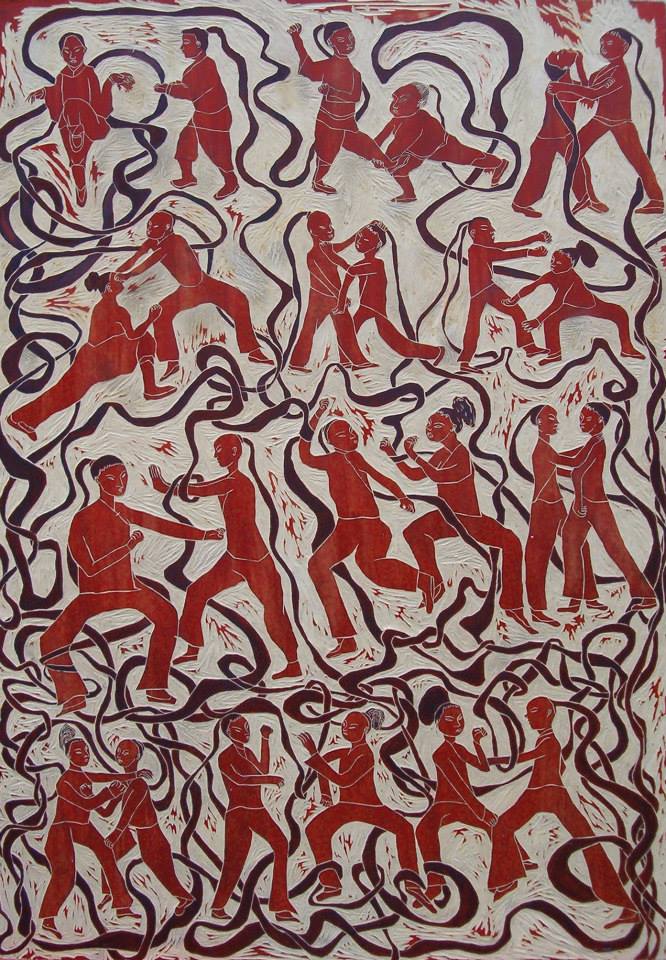
The bachelor's degree exhibition, made in 2003 and 2004, was called by Zikic herself a red phase — and that describes it precisely. All the works share the same red: a particular shade between vermilion and carmine, the colour of blood, the colour that Michel Pastoureau, in his history of the colour, calls "the archetypal color" — the first colour humans mastered, fabricated, and reproduced. For many ancient cultures, he notes, the word for red was the same as the word for colour itself. There is nothing accidental about Zikic choosing this red as the ground of every work.
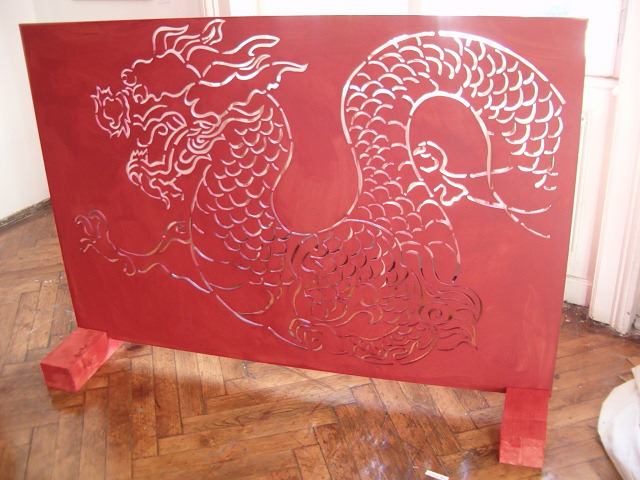
The interest in ancient cultures that had drawn her to the Nepal photograph continued here. Among the red works is a large MDF panel with a dragon cut through it — a figure that belongs to Asian iconographic traditions she had been studying alongside African and Amazonian imagery, all of them sources for an exploration of how ancient cultures encode knowledge in symbol and form. The dragon is not decoration. It is the result of asking what happens when a figure from ritual art is translated into drawing research: when the line becomes an absence, and the light passes through.
The series was also a sustained investigation into what drawing can mean — not the default definition of line on paper, but something larger. What is drawing when it is on a wooden board, standing on its own legs in space? What is it when the line is not added but removed — carved into the surface so that it becomes a relief, something you could run your finger along and feel? One of the panels was cut through entirely with an electric saw, creating an openwork structure through which light passes; others were carved by hand with wood knives; others were charcoal drawings directly on the red acrylic ground, figures engaged in collective movement — something between martial practice and ceremony — the white marks of the carved ground flickering beneath them like fire or breath. The works in the exhibition stood as paravans — freestanding screens — in a space visitors could move between. They were simultaneously drawings, reliefs, paintings, and installations. The red held all of it together.
Photographs of the works read as drawings, as flat marks, as line. The fact that some of them are three-dimensional — that the surface has depth and can be touched — is not obvious in all reproductions. That gap between what you see at a distance and what you discover close up is something that would recur.
What Is Reality in the End
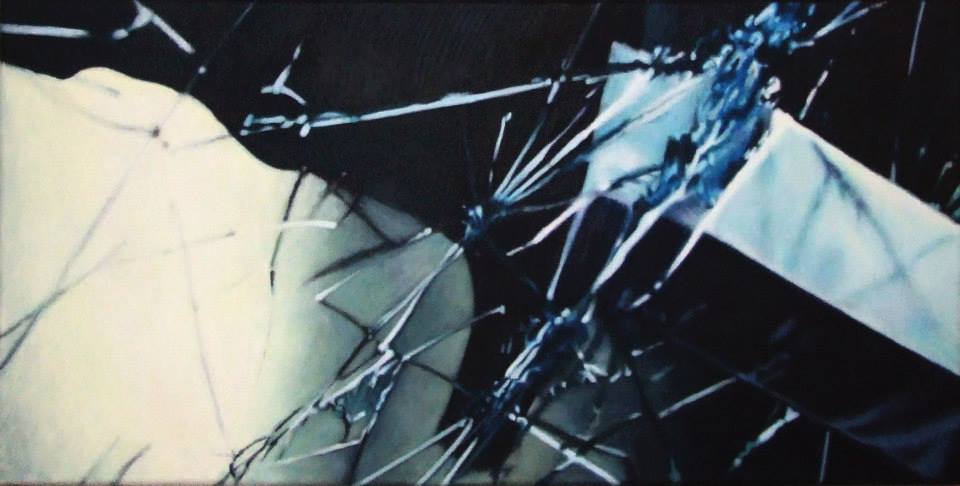
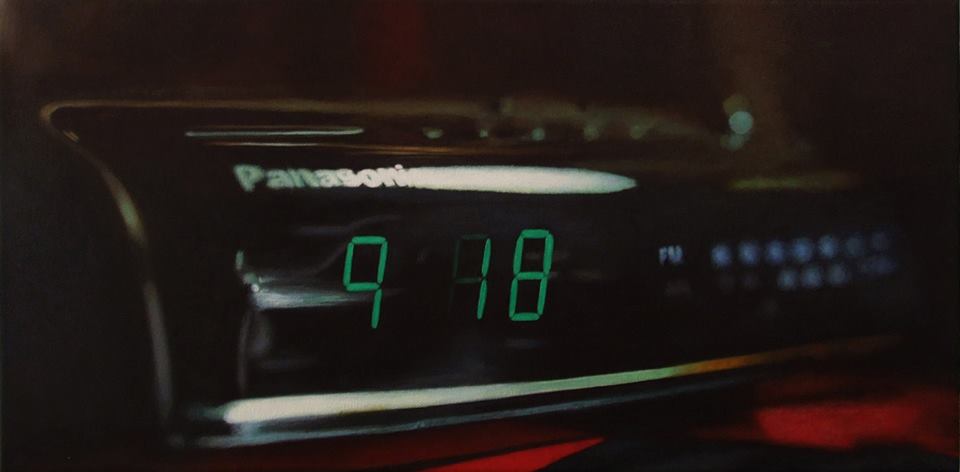
The hyperrealist paintings were her master's degree exhibition. Over roughly two years, working in acrylic on canvas, she painted a series of images taken from film stills — chosen deliberately for their illegibility.
This was the era of DivX, when movies were being digitised and copied onto CDs at low resolution, sold cheaply, watched by people who had never before had access to the whole history of cinema in a single afternoon. She watched many action films and began to notice the grammar of the genre: certain images repeated across films — a stopwatch counting down, a tangle of wires before an explosion, a laboratory flask, reflections on a car hood, a knife, shattered glass, a partial view of a body, a clock glowing in the dark. These were fragments of a reality that was not even real: cinematic reality, already once removed from life, now further degraded by the compression of DivX encoding into grain and artefact. When she painted from those stills, she painted the grain too. Layer by careful layer of acrylic, with the canvas held in her lap and small brushes making marks no larger than a few millimetres, she reproduced not just the image but its degradation. "What is reality, in the end?" she asked. There are so many layers between what happened and what we see.
The compositions were chosen to confuse. Something is always partly out of frame. The subject is never centred, never obvious. One painting shows a Panasonic clock radio — its green digits reading 9:18, the surface of the device rendered with uncanny precision against deep shadow — mundane to the point of strangeness, a fragment of ordinary time made to feel like a countdown. Another shows cracked windshield glass, the geometry of its fracture almost entirely abstract: a blade barely visible at the upper edge, recognisable only if you already know to look for it. A professor, encountering this piece, could not identify what she was looking at. Other faculty had to point out the blade, the handle, the cracks propagating through the safety film. It is not a failure of perception. It is the work doing precisely what it was designed to do. You are left with the surface, with the craft, with the question of what you thought you were going to see.
The formats were mostly 30 × 60 cm. There was one exception: a 2 × 1 metre canvas from the film Domino. All were painted with the same patience, the same accumulation of thin layers. After two years of this — of what she called "millions of small movements" — she was exhausted. Something had to change.
The Light Changed Everything
When she arrived in Barcelona — around 2010, 2011 — the shift was physical before it was artistic. Belgrade had been grey winters, studio interiors, images found rather than lived. In Barcelona, she started going outside. She had her first iPhone. She found an app called Hipstamatic.
"When I arrived here," she wrote in a text prepared for the Fotoarte Barcelona photo night in May 2026 — a projection evening where she presented the series alongside three other photographers on a large screen — "the colour and light surprised me in a way I hadn't expected. I needed to find a way to capture it." Hipstamatic, in its early form, allowed you to choose virtual film and lens combinations, or let the app choose: the results were images with transformed colours, intense grain, a visual language that belonged to no other camera at the time. For a painter, this was not a limitation. "Imperfection was the point."
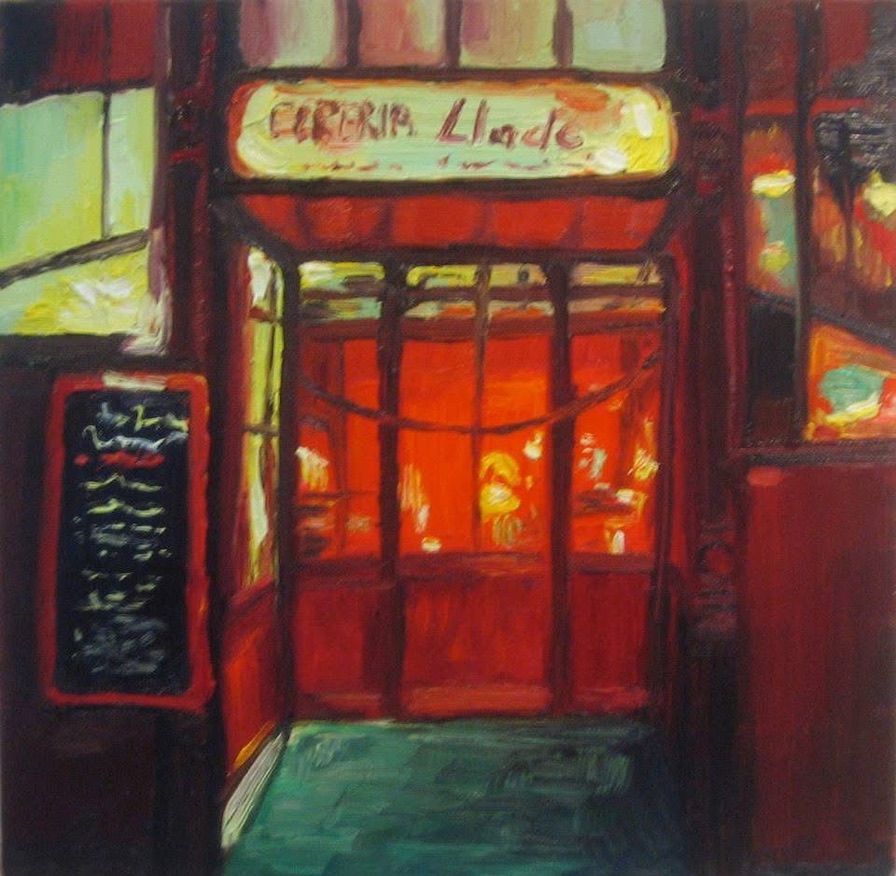
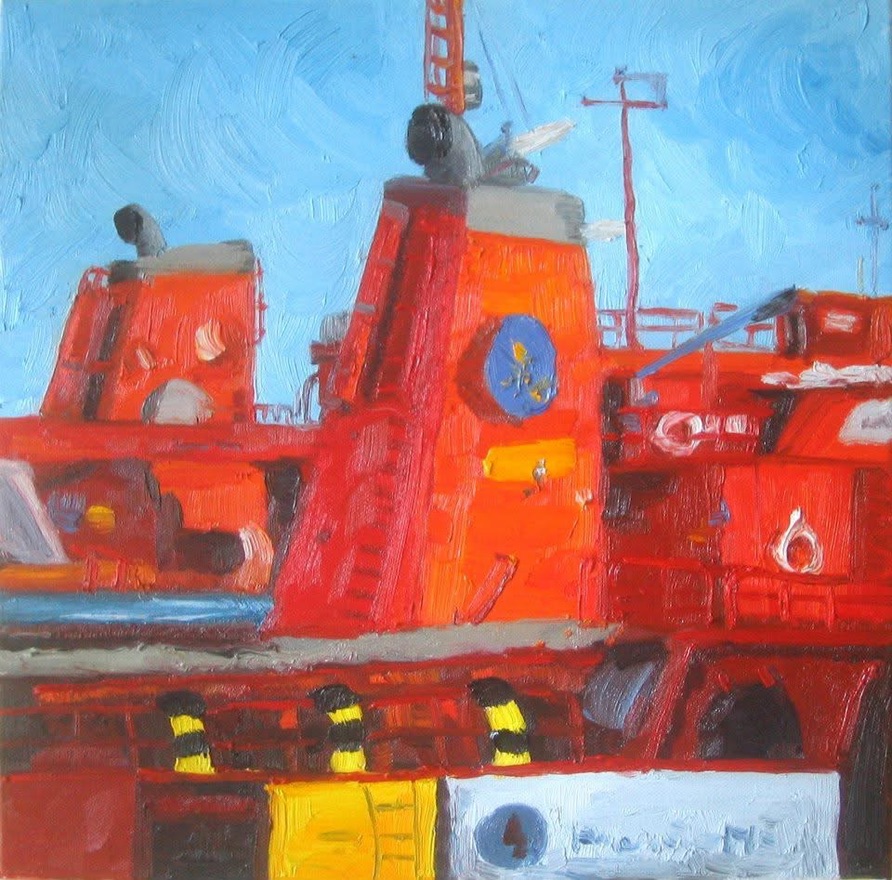
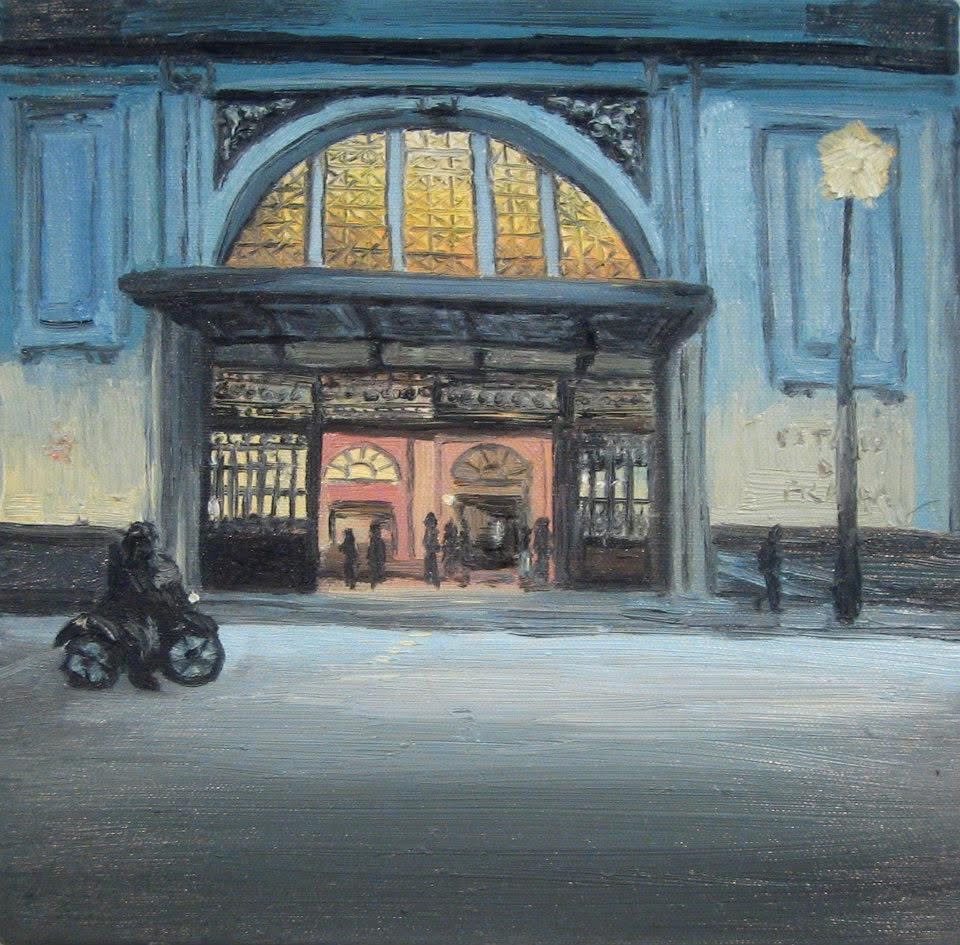
She was living in the Barceloneta neighbourhood, close to the sea. She photographed the beach, the streets, the morning and evening light — not with any plan, but because she was there and she had her phone. The photos were meant to be reference material for paintings. And they were: the oil paintings she made from them in 2011 and 2012 are square, because the photos are square, and gestural, because after two years of hyperrealism she needed to feel the brush move freely. They are saturated, full of paste — not thick impasto but visible gesture, the hand present in every stroke. A bar facade at night, its sign glowing red and orange against the dark. A grand theatre entrance at dusk, the interior gold visible through the arch, a figure on a motorcycle small in the foreground. A rescue vessel in the port, its hull entirely orange, painted close and fast. The colours have the same quality as the photographs: intense, warm, a little unreal. The same light, different hands.
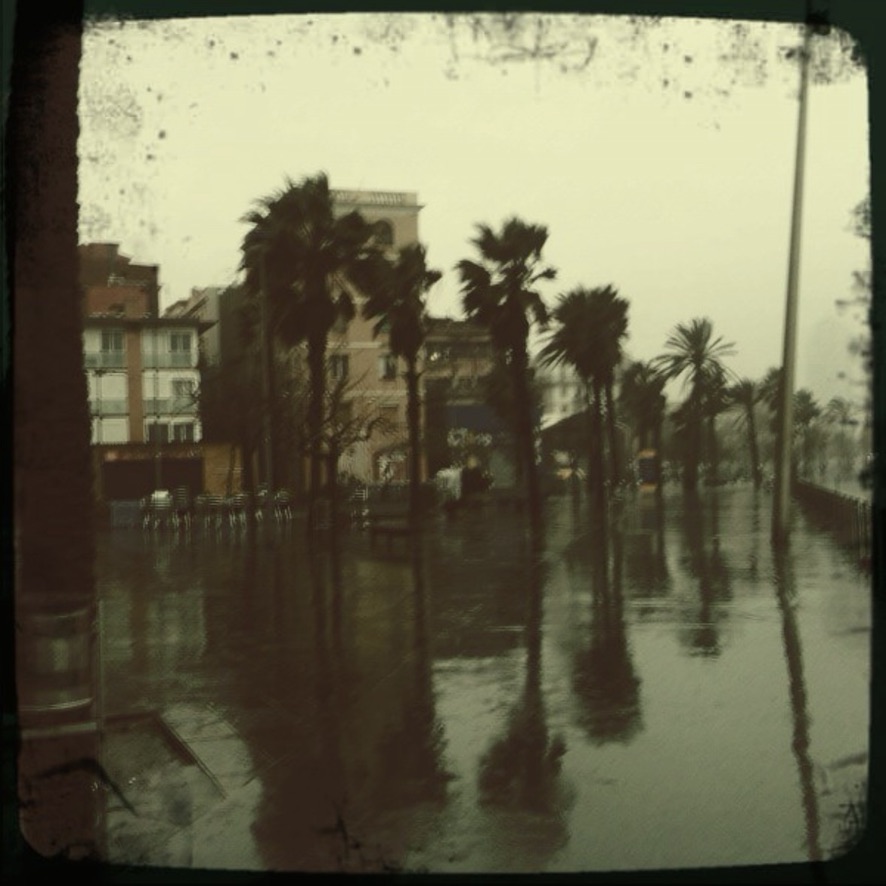
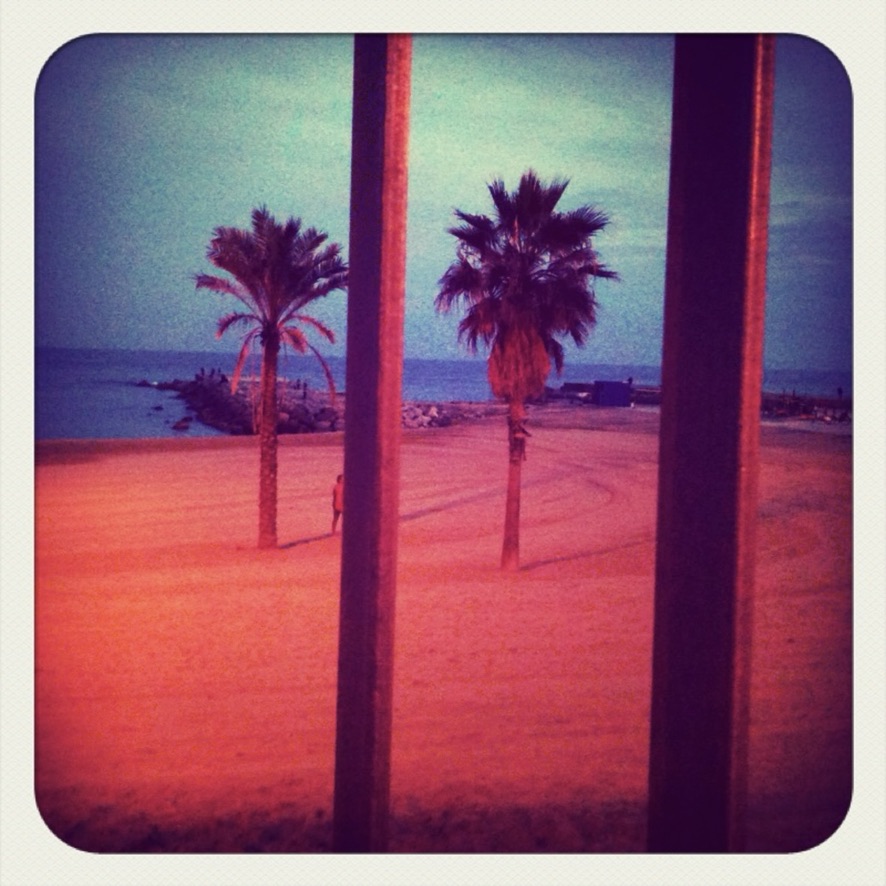
The Hipstamatic series from 2011 to approximately 2015 has a visual coherence that comes from the limitations of those early iPhone cameras as much as from her eye. The grain is inseparable from the colour. One image: a rainy day, palm trees reflected in flooded pavement, everything darkened to sepia and shadow, the vignetting of the early Hipstamatic frame pressing in from the edges. Another: the beach seen through what might be bars, the sand burning orange-red, the sky turquoise, the palms between them — a colour shift so extreme it reads as chromatic invention rather than documentation. Later phones, later versions of the app, produced different results. She still uses Hipstamatic. The comparison between then and now, she noted, is becoming increasingly interesting — not as a record of technological change but as a record of how a visual language evolves inside a single practice over time.
The square format has stayed. Whatever camera she uses, she photographs in square. "It has become a natural way of seeing," she said.
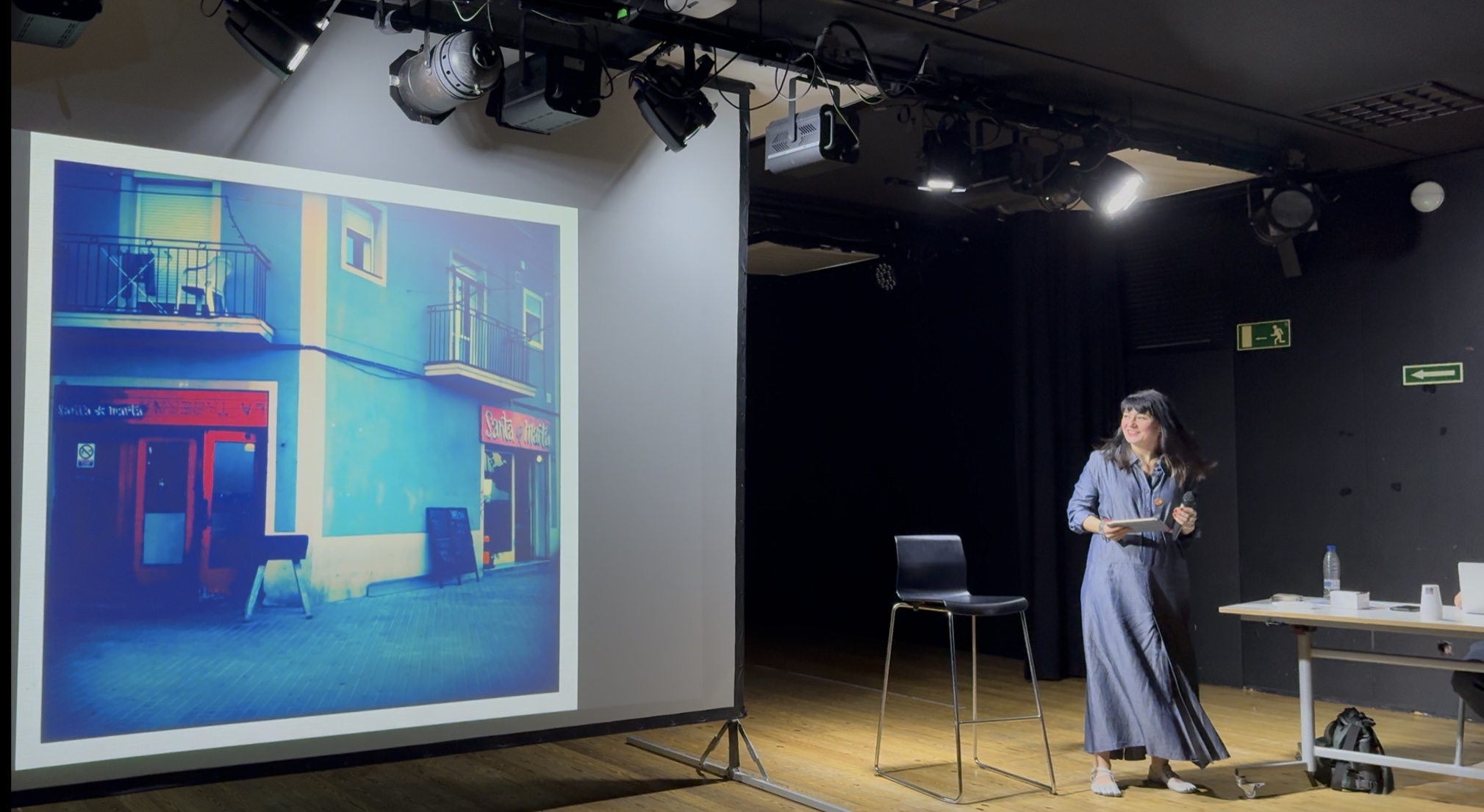
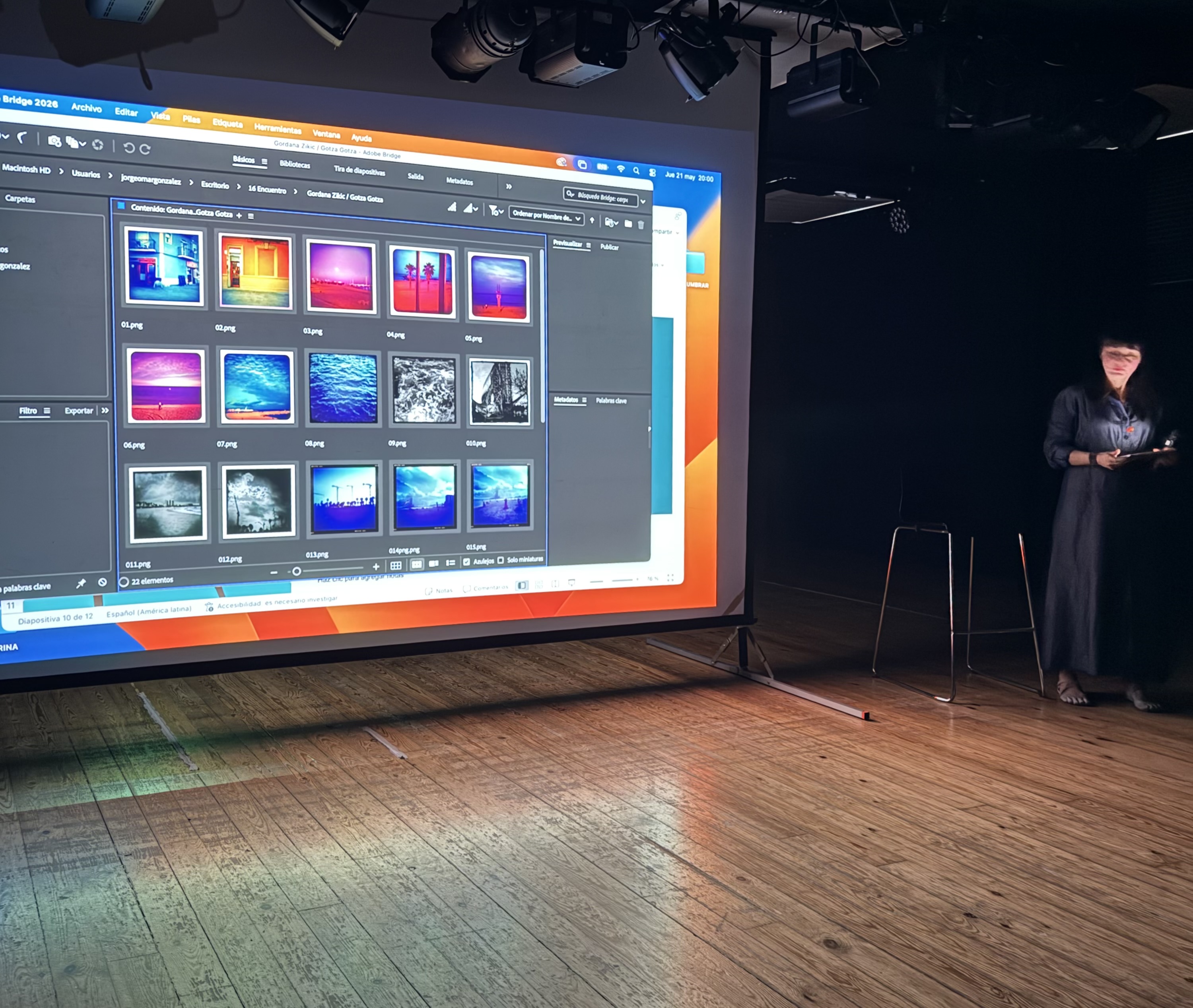
At Fotoarte, seeing these photographs projected on a large screen — images she had always known only on a laptop — she experienced them differently. The wider shot from the evening tells it clearly: on one side of the stage, a wall-sized projection showing the full selection of photographs as a working grid in Adobe Bridge, twenty-two square images filling the screen from edge to edge — the whole visual language visible at once, the colour range, the consistency of format across years. On the other side, Zikic, standing with her notes. The intimacy of a working archive made suddenly monumental. "I was amazed how they looked at that scale," she said. "I usually see them only on my screen. This was a completely different experience."
The Archive That Made Itself
What this session made visible — across Nepal festival figures, red MDF reliefs, hyperrealist film fragments, and Hipstamatic photographs of Barceloneta — is not a single continuous arc but something more like a series of deep immersions, each distinct in its logic, each made with total commitment. The Nepal works: one photograph, one year, ten variations. The red phase: all one shade, all one question about what drawing can be. The hyperrealist paintings: two years, millions of marks, a question about reality that had no comfortable answer. The Hipstamatic series: fifteen years, one neighbourhood, one format, accumulated without design.
None of it was planned as an archive. But archives happen anyway. It was only when she was invited to present twenty photographs at Fotoarte that she had to look back across fifteen years of images and decide what they were. "Now I'm looking differently at my work," she said. "I'm looking differently at how I can curate my own work. What it means. How I can choose photos from a specific time, or with specific qualities, or only water, and then rethink all the different ways of what I can do with all this."
This profile covers only a slice. There are video works from around the same period that weren't discussed. There are other bodies of work. Gotza's practice extends in many directions — and future VSG articles will find their way to those. For now, for members who have known her primarily through her photography, her sea studies, her shamanic-inflected installation work, or her years as a residency director and community builder: these earlier works are where some of the same questions were first being asked, in different materials, in a different city. The questions themselves have not changed that much. She was always interested in what things are made of, and what gets lost in the looking, and where, in all those layers between experience and image, the real thing goes.
Follow Gordana Zikic @gotza_gotza on Instagram · gordanazikic.wordpress.com
This article is based on a presentation and discussion from a Virtual Studio Groups session, 24 May 2026. Gordana Zikic is an interdisciplinary artist and residency director based in Barcelona.