
When the Image Disappears: On Photography, Memory, and the Art of Being Ready
A conversation with Joachim Froese, a photographer and academic from a recent Virtual Studio Groups session
Every photographic image — analogue or digital, historical or contemporary — has a limited lifespan. For this artist, the fragile threshold between permanence and loss is not merely a technical challenge to overcome. It is the central subject of the work itself.
He joined our latest VSG session from a residency at The Local Air Valencia, moving between his two homes: Brisbane, where he is based, and Berlin, where his next major exhibition will open in August. Photographer, academic, and educator, he spoke about these roles as inseparable parts of the same practice. Teaching, he was quick to emphasise, matters as deeply to him as making the work itself.
Salt, Silver, and Sunlight
At the centre of his current practice stands salt printing — the earliest working photographic process, presented by William Henry Fox Talbot in 1839. The method sounds deceptively simple: a sheet of watercolour paper is floated on a salt solution, coated with silver nitrate, layered with a negative, exposed to ultraviolet light, then washed in another salt solution, washed again, and fixed. From start to finish, a single print can take four to five hours to produce.
It took him nearly a year of ongoing experimentation before he felt he had sufficient control over the process to use it for serious work. Salt printing is acutely sensitive to its environment. Temperature, humidity, and atmospheric conditions all shape the final image. A cold rainy day yields a different print from a hot summer afternoon. No two works are ever exactly alike.
For him, this unpredictability is not a flaw to be eliminated but an essential part of the medium itself.
His series Entangled centres on seedlings cultivated specifically for the project, tracing the intertwined histories of photography and botany. Both Talbot and John Herschel — two pivotal figures in the invention of photography — were also botanists, and the work draws on this shared lineage. At the same time, the series gestures toward a broader reflection on the entanglement of human and plant life, each subject to cycles of growth, transformation, and decay.
His more recent series, Alchemy, exhibited in Brisbane earlier this year, turns to scientific glassware, skeletons, and decaying fruit. The fractured laboratory vessels evoke a damaged relationship: with the environment, with chemistry, and with photography itself. These objects belong to the material world of analogue image-making, and their breakage signals a rupture between that tactile history and the immaterial logic of the digital present.
Despite the painstakingly handmade nature of the final works — including frames he constructs himself — the source image always begins as a digital file. It is a tension he deliberately sustains between old and new technologies, permanence and fragility, control and contingency.
A Mirage of Another Planet
The most conceptually ambitious body of work he presented is Turned Towards the Firmament.
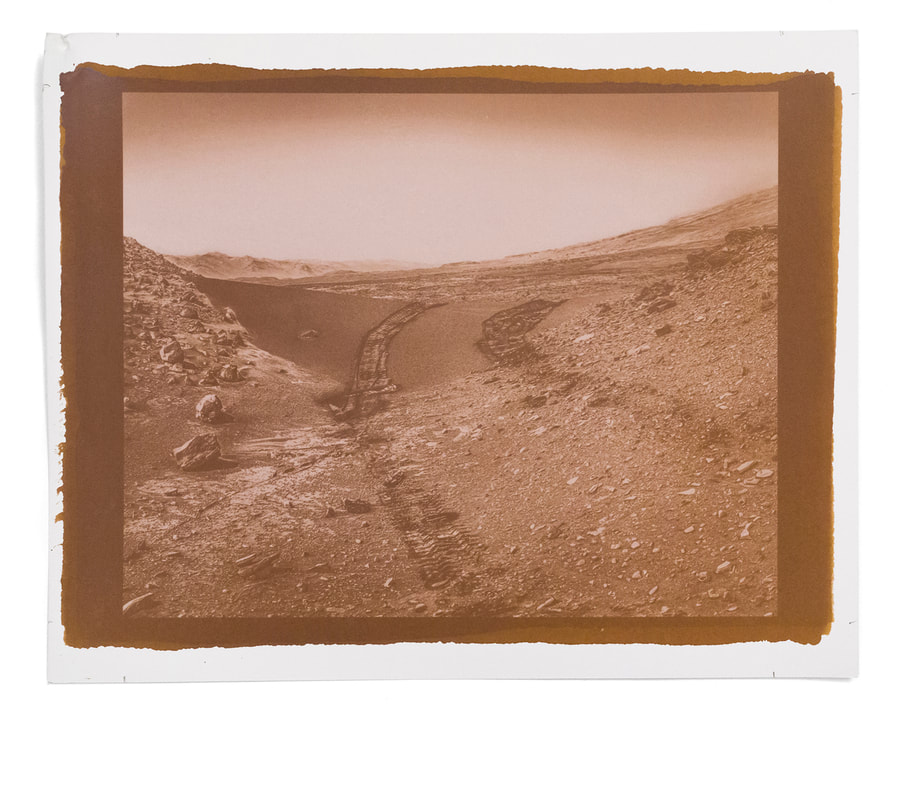
The title quotes the French scientist François Arago who in 1839 in Paris launched another historic photographic process: the daguerreotype. In his address, he speculated that photography one day might be 'turned towards the firmament' to reveal distant planets, their atmospheres, and geological formations. What seemed like fantasy at the time has since become reality. Since 2004, NASA's Mars rovers have transmitted detailed images of the Martian surface — landscapes that appear strangely Earth-like yet remain fundamentally alien and hostile to human life.
Drawing on imagery downloaded from NASA's archives, Froese translates photographs of the Martian surface into salt prints which he doesn't fix. The prints are washed and stabilised, but they remain sensitive to ultraviolet light and are therefore destined to shift, fade, and ultimately disappear.
Each print is housed in a folder, featuring a digital reproduction of the print inside. Visitors are invited to remove the folder from the wall and carry it to a designated viewing area to examine the original print under dimmed interior light. If taken into daylight, the image would slowly darken and eventually vanish.
For his forthcoming exhibition at Brotfabrik Gallery in Berlin — opening on 14 August and running for six weeks — he is extending the project into a far more ambitious installation: a large-scale Martian landscape composed of 107 completely untreated prints. The work depicts a terrain no human being has ever physically seen, assembled from machine-generated images transmitted across space. The entire panel will begin to fade and ultimately disappear within seven to ten days.
Every third day, Froese will return to the gallery to reprint sections of the work. The exhibition becomes not only an installation but an act of continual maintenance — an attempt to sustain a mirage against its inevitable disappearance.
In his view, the dream of human colonisation depends less on scientific reality than on photographic persuasion. Without images of the Martian surface, few people would imagine it as a destination at all. The photographs render the planet strangely familiar: expansive horizons, rocky terrain, landscapes that appear traversable, even inhabitable. Yet they remain an environment toxic to humans.
The endlessly fading and restored panel quietly reflects on this tension between image and belief. At the same time, it reaches toward something older and more fundamental: photography's enduring relationship to mortality, disappearance, and the unstable nature of memory itself.
Photography and Death
For Froese this relation is theoretical but also personal. In 2006 he cared for his mother who was dying of cancer. During this time, he made a work called Portrait of My Mother, for which he photographed every book she ever owned rather than her face. This portrait shows her knowledge and a life lived — not what she looked like.
The idea that photography is a construction is central to his work. Photography does not simply reveal reality; it shapes the way reality is seen. Professional photographers understand this instinctively, while many people still hold to the belief that the camera records the world objectively. But photographs are always framed by decisions: where to look, what to include, what to exclude, and how to interpret what appears before the lens.
The VSG group brought their own perspectives into this. Gotza offered a shamanic framework: time is not linear but spiral — all moments exist simultaneously, not receding into the past but remaining present in a different layer of time. The shaman does not go "back" to retrieve something lost; they navigate to where it still exists. Photography, from this angle, is not a capture of something gone but a technology for making the always-present briefly visible.
He found this compelling and added a historical dimension: this entire framework of visual memory is only about 100 years old. Before photography was accessible to ordinary people — roughly from the 1920s onward — you did not have your own life in images. You had stories, written documents, perhaps a painted portrait if you were wealthy. Photography changed something fundamental about how humans experience time, memory, and identity.
How Technology Changes the Way We Think
Joachim Froese moves fluidly between historical and emerging technologies — from salt printing and analogue processes to digital photography and, more recently, artificial intelligence. During his residency in Valencia, he began experimenting with Adobe Firefly, integrated into Adobe Photoshop, as part of a new body of work inspired by La Seo Cathedral, home to one of Europe's most significant collections of medieval tapestries.
While studying the densely woven imagery, he became fascinated by the animals partially concealed within the compositions — dragons, bears, and other fragmented creatures embedded in the fabric. Cropping these details from photographs of the tapestries, he used AI tools to imagine and generate their missing bodies, later presenting the resulting images as a handmade shadowbox.
The project emerged partly from a desire to understand a new technology through direct experimentation. Yet it also connects to a recurring concern throughout his practice: the use of contemporary tools to re-examine historical material, bringing the oldest forms of image-making into dialogue with the newest. Across these works, the question is less about technological novelty than about what each medium enables, transforms, or obscures.
He approaches AI with caution rather than enthusiasm. His principal concern is environmental: the immense energy demands required to sustain large-scale AI systems. He compared the growing infrastructure behind generative AI to the resource consumption associated with cryptocurrency mining.
More broadly, his work examines how technologies reshape perception itself. Digital photography offered mobility and freedom: the ability to work from a laptop anywhere in the world, to move into colour without the toxic chemistry of traditional darkrooms, and to embrace a faster, more flexible workflow. Salt printing, by contrast, reintroduced slowness, tactility, and an intimate responsiveness to environmental conditions.
"These different technologies make us work in different ways," he reflected. "They change the way we use the medium, and they change the way we perceive it."
Being Prepared When the Door Opens
Late in the conversation, after the formal presentation had ended and the discussion became more relaxed, the focus shifted toward professional practice — documentation, visibility, and readiness.
He recalled an incident from early in his career. A curator organising a major travelling exhibition of Australian photography contacted him on a Thursday afternoon requesting slides of his work. In the pre-digital era, portfolios still travelled by mail, but he already had a prepared set of slides ready to send. They arrived on the curator's desk the next morning, while several other artists responded days later. He got the exhibition.
"It wasn't only the quality of the work," he said. "It was being professionally prepared when the opportunity appeared."
That same pragmatism shapes his approach to documentation. A website, he argued, remains the backbone of a professional practice: comprehensive, updated regularly, and carefully archived. Instagram is secondary but still important. He admitted resisting the platform for years and believes that reluctance affected his visibility. Now he photographs exhibitions before opening and posts documentation while the work is still on view.
On social media, his philosophy is simple: quality over volume. Frequent posting without substance quickly becomes noise. Less frequent, more considered updates are ultimately more valuable.
What exists online, he noted, is not the artwork itself but its documentation — and for most people, that documentation will be their only encounter with the work. If artists choose to participate in the exhibition world, the professional framework needs to be in place before the opportunity arrives, not assembled afterward in haste.
If you want to follow Joachim on Instagram: @joachimfroese