Project PLAY — Juan Antonio Cerezuela
3 texts by Mark Fish as reactions to Project P L A Y
Juan Antonio Cerezuela is the artist selected for the exchange program between @homesessionbcn and @belgrade_artist_in_residence with the support of Institut Ramon Llull.
Juan Antonio Cerezuela (Cartagena, 1982) is a visual artist based in Barcelona. He has exhibited his works in Barcelona in centres such as Born CCM, Arts Santa Mònica, or Fabra i Coats. Some of his solo exhibitions are en horas bajas (La Espronceda), Blanco y ceniza (13ESPACIOarte), La memoria ignífuga (Fundación Gabarrón) and Full Blanks (CEART). Since 2018, Cerezuela develops his work in the art centre La Escocesa.
In his work, the correlation between language, time and space is usually present through installation, performance and site specific works. In them, elements and issues such as silence, invisibility or illegibility are constantly repeated to bring to light different tensions.
Can I quit being an Artist?
I started asking myself this question, moved by some mixed feelings, wondering if there are other ways of being — or not — in art. In fact, my first proposal in response was to use the production budget of the Homesession and Belgrade Exchange program to process my cessation as an artist.
However, the answer to this question started to raise many other questions which confronted me with some contradictions, driving me to a dead end. I needed to escape, to move position…
I needed to move…
During my first days in Belgrade, an idea came to my mind while I was walking through the city and I found some basketball courts in the way. I wanted to play basketball, and I wanted to look for a personal trajectory within the city that allowed me to play. Then, and with the help of residents and friends from Belgrade, I found basketball courts and playgrounds across the city.
One of the things that strike me here in Belgrade is the fact that these courts — as well as playgrounds — are very visible, well-maintained and generously spread across the city. I don't know if this abundance has to do with some kind of cultural or sporting tradition, or maybe with the fact that Yugoslavia hosted the 1970 Basketball World Cup, but what strikes me most is how present, how democratic and how public these spaces are.
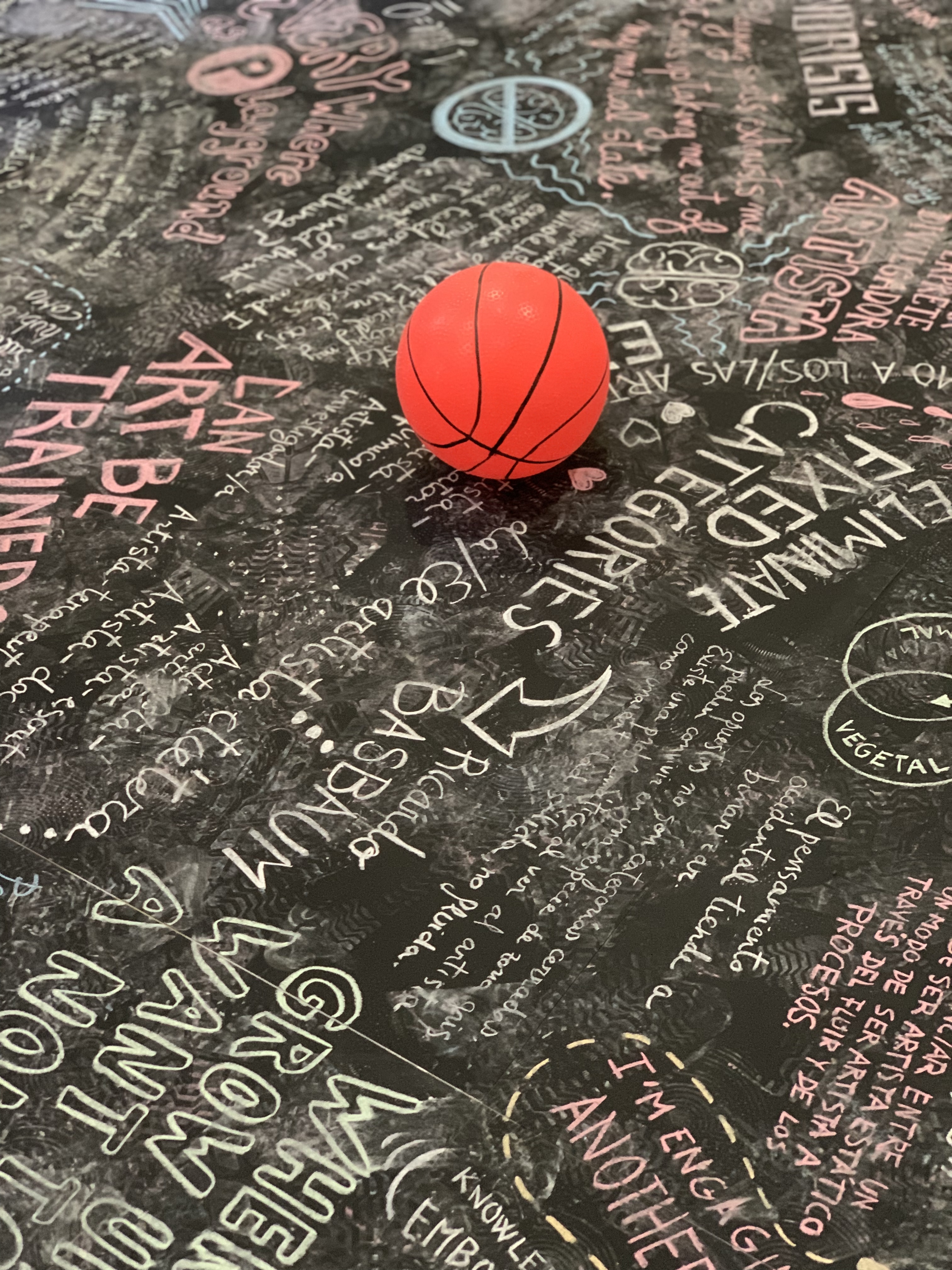
To translate this research into an artistic work, I decided to visit as many courts as I could during my residency, and have a basketball play session on each of them. After that, for each court, I decided to produce a score based on the plays, to generate a map of the city through these sessions, and to record some videos and photos.
Text 1 — by Mark Fish
P L A Y
Play, as in opposite of ENJOY! *
Of course, enjoy in superego, that is. Play, almost like p r e y. That is, pray for nothing, so you can be an artist, again.
There is a down spiral movement produced by the cut from "I don't want to be an Artist" to "I want to be a basketball player". From be the entitlement produced by the superego injunction( to enjoy ), to become nothing at all- the subject in its empty form. Well, you might as well play than.
Playing is movement that functions like praying for answers. Answers, which are memories from the future, as always, knowledge in the non known. Kids play because they choose between all the options what to become. Firm, stern identity is out of play. The Artist can enjoy, but can not play. An artist can though**, because It is nothing prior to ever becoming anything stern. An artist is a stern free form of playing for answers.
This artist is just a player- fast moving subjectivity- basketball is a mere surplus. And surplus is for us. Nothing stays with artist, the ball comes to play for us. Surplus is always for the other and that's where the basketball becomes the artwork. And the artist is saved from The Artist.
The Artist is dead, long live the artist!
artist: "PLAY!"***
* search for S.Žižek, injunction to enjoy
** but cannot enjoy; enjoyment has gone 'out of reach', gone to sinthome ( look for J. Lacan, the Sinthome )
*** a discipline devouring of superego
Text 2 — by Mark Fish
From Symptom to Sinthome*,
Or
From "I don't want to be an Artist" to "I want to be a basketball player"
In saying what you don't want you are actually saying what you are- you define the terms of your identity. But in saying what you want, you are actually saying that you wish a thing for which on the other end of that sentence it is required something totally contingent, not thought through even though thought of. Something that divides subject from the predicate. "I wish/want" says actually that I don't know what is my desire, incumbent of what the rest of the statement is, for it can be whatever, because as such it stands for the utter randomness of nonknowledge. Or, I desire what I don't know/have no knowledge of. From a thing I can enjoy ( through symptom ) to a thing I can not even enjoy ( the sinthome ). Form identity to a subject. From a fixed image to a nothing. From the Artist to a basketball player. Consequently, the only true artist is the basketball player.
Where the Artist could not say no to himself (being an artist), where he could not abandon, devoid himself from the compulsion, the basketball player can do so through the sound, unequivocal NO of the body- you can not be what you can not become. The "knowledge" in the body sets the limits where the mind (through compulsion) can not push through. Mind abides to the process ( of the game ), yet the only the body can "know" the goal. It sets the aim in the non-known. It aims in the open, behind the horizon. It has the "knowledge" of the desire at hand and for that reason exactly it is the only NO that can be ushered.
It is important to have that kind of NO, because it breaks the confines of an Ego, it de-limits the identity. It limits it again. It's opening by limiting anew. For one to contradicts oneself as such, one has to "choose" an orthodox randomness, an utter yet precisely specific anything. Something that only upon "choosing" can come to one's senses as an obvious NO, a no that can not be wished ( uttered by simple negation of the predicate ), but desired. From " I don't want to be an Artist" to "I want to be a non-Artist/ I want to be a basketball player". Not 'I want to be something that I am not', but 'I want to be something which I am non ( I have no knowledge of ), while being an artist'.
I want to transgress from the Artist to an artist. From the Artist as title/entitlement/bureaucrat to a subject/nothing/free/ basketball player/all of the above.
For it to be "done" one has to become what one desires to be through the function of oneself as a foreign object, a foreign body. In this case, of an Artist trying to become an artist, one does it through the function of the body as the basketball player. One's body becomes a foreign body to oneself- a strange, distant, unfamiliar and surprising object, with odd, unexpected and capricious behaviors. It hurts, collapses, "speaks" unclear, yet unavoidable decisions. It functions for itself. Which is a weird experience for the in itself of the one whose body is the foreign body. Subject that has nothing to do with the object, yet it is fully, for the fact, the object( of that body ). We need a foreign body to speak ( for us ) what we can not speak of. We need from that utter random otherness to say notoriously unambiguous NO. We need some-body to care, to say no at the end of our need and the beginning of our desire. That NO is the horizon from which our new identity transpires, allures. It is a NO that you wish to transgress, and that is your desire- the goal without an aim, but with perpetuity.
The choice of 'whatever', of something that is just 'why not' is the most precise decision one ever makes, for there is only one 'whatever' and 'why not' at a time and only the foreign body ( the other/otherness ) "knows" it. My conclusion is that the artist made exactly the right choice by choosing randomly to become a basketball player in order to stop being the Artist. The exact randomness of choice makes it a concept that tights the contradiction, keeps it in check from orchestrating an otherwise all to common confusion one all the time faces between this and that. Something on which every neurosis flourishes. This and thats of this world sometimes, not too often, come to a halt when some-body puts it/them together in a concept that one can think of and consequently be (of). Contradicting becomes thinkable, like the 'Artist is the basketball player', in endeavor to become one.
The artist told me that in his training to become the basketball player he has a sense of mind as a Father and his body as that of a child. Desire is always defined/found/founded in non willingness/not being able to obey. And I thought, where is the mother than? Well, the mother is the artist.
* J. Lacan
Text 3 — by Mark Fish
The Surplus Ball
Pass is like a fate- a something that once has happened makes sense of all that had happened.
Ball is a peculiar object, taking a control of which sunders it from other objects we subsume under our skill sets. We never take control of it, we accustom our movement, we shape our body relative to it. It's a process of successive loss of balance, catching it in every next moment which instantly becomes loss( of balance ) again and again, as long as we are in interaction with it. The moment the interaction stops, separation is absolute, for there is no relation with it outside of being a part of its movement. You become 'one with the ball', for that is one object that can not exist out of realm of movement. And as such, movement in relation to somebody who can relate to it. Outside of that, possibility for the ball is to be only the ball.
What happens when you insert the ball into the group of people, individuals in a specific symbolic constellation- the structure that is the game? The ball becomes an impetus for movement, and not only that, it becomes a moving focus of attention, around which the relation is shaped into shifting relationships. The becoming of relationships as it moves through the structure gives validity the structure at all, otherwise it would be just a dead letter. The ball is a surplus that shapes the reality- giving the structure the life in a form of a game- as is the point of every surplus. It keeps things moving, while it is nothing more that an inert object. It become alive only in being the moving point of becoming relationships that make individuals into subjects (of the game).
Moving surplus means becoming of relationship that becomes only in relation to this surplus and quickly fades away, for it never was solid or lasting, because it is directly dependent on unpredictable shape- an impossible relationship, that has it stakes on something that last only for the moment of balance. Whoever was in possession of balance, remembers it, for you posses it only in memory.
But than, something happens and that ball, that surplus, finds its way through the structure and into the game in a way that impossible relationship becomes evident and evidently unique, almost possible. It becomes a pass, something new, an impossibility that found its way into the world. Something that for a moment structures the world in a way more meaningful that any structure ever could. The pass is like falling in love- contingent event that makes up for the meaning of it all.