
The Sea That Cannot Die
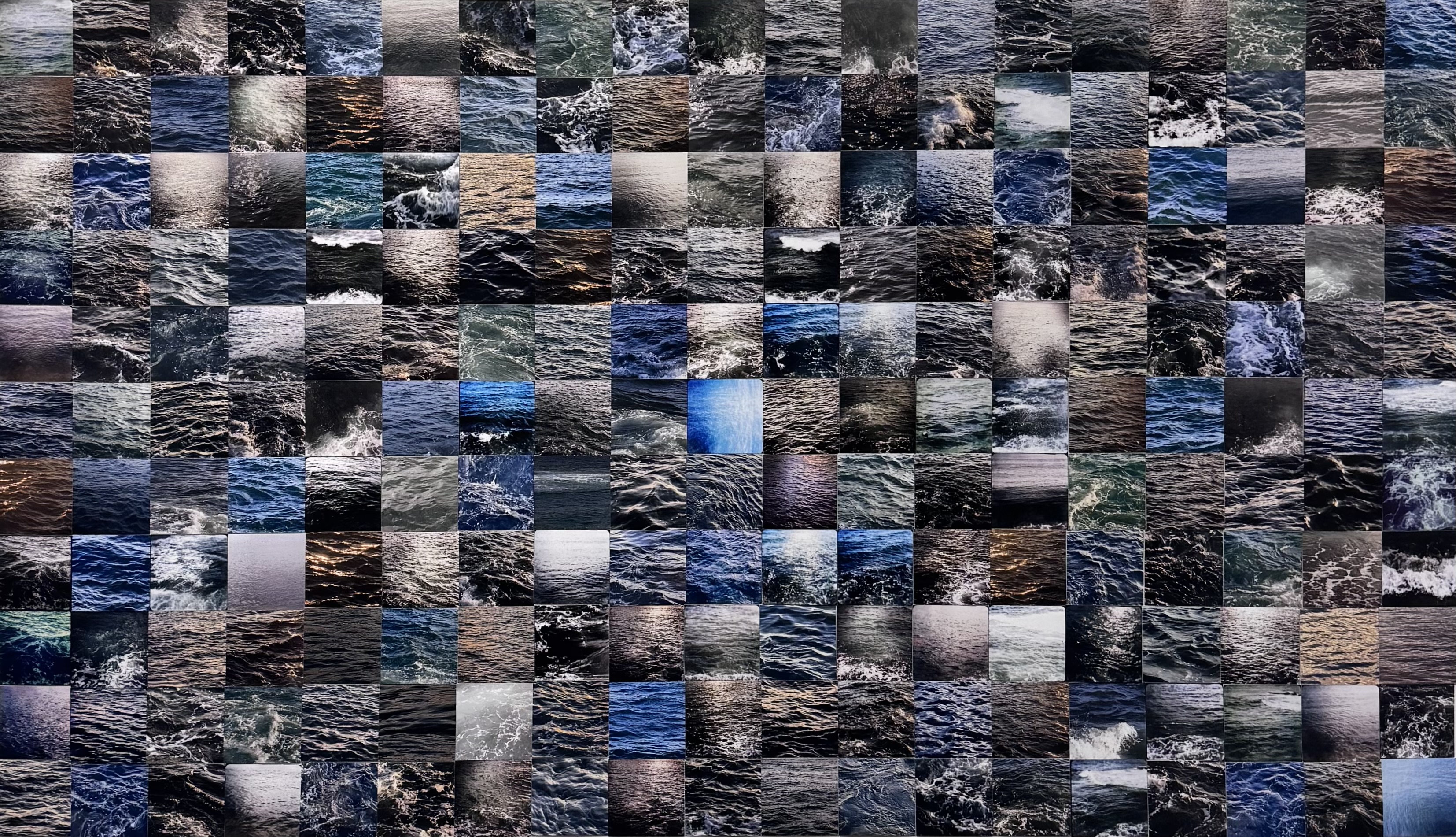
El Mar Hirviendo — 220 Surfaces. From the solo exhibition El Mar Hirviendo, The Local AIR, Valencia, 2026.
By Gordana Zikic · The second in a series on shamanism and contemporary art
Most people who live near the sea take it for granted. They walk past it, photograph it, complain when it is cold. They do not wonder about it. What is surprising, when you start to look, is how recently that indifference was learned and how different, across most of human history and most of the world, the relationship with the sea has actually been.
In the first essay in this series I described the contemporary artist as a shaman-like figure: someone who tunes into frequencies of reality that ordinary life filters out, and makes them perceptible to others. In this second essay I want to explore one frequency in particular — the sea — that has been at the center of shamanic practice across many different cultures, and that has also shaped my own artistic work over the past fifteen years. These are not unrelated observations. The sea, it turns out, has always been understood as a threshold between worlds.
Before the beach was a destination
The idea that the sea is a place of leisure and pleasure is, historically speaking, very new. Before the eighteenth century, European culture regarded the ocean primarily with fear. It was the domain of storms, monsters, and the dead — a chaotic remnant of the biblical flood, the edge of the known and the beginning of the terrifying. As the historian Alain Corbin documents in The Lure of the Sea, the classical and medieval periods knew almost nothing of what we now consider natural: the attraction of a beach, the pleasure of bathing in waves, the desire to spend time at the coast for its own sake. The shore was associated with catastrophe and repulsion. Sailors who fell overboard were often not expected to be saved; even those who spent their lives at sea frequently could not swim, on the grounds that swimming was unlikely to help in rough water anyway.
The transformation came between roughly 1750 and 1840, driven by a convergence of Romantic aesthetics, Enlightenment medicine, and industrial capitalism. British doctors began prescribing sea air and cold seawater immersion as cures for melancholy, gout, rickets, and what was then called hysteria. The first seaside resorts opened in England — Scarborough, Brighton — and their clientele arrived not for pleasure but for treatment, entering the waves in heavy costumes under medical instruction. Only gradually did cure become leisure, and leisure become the dominant mode. By the time railways made coastal travel affordable for the middle classes, the beach had already been aesthetically repackaged by painters and poets as a site of the Romantic sublime. The fear was not abolished but transformed: the ocean became beautiful precisely because it was still terrifying.
This history matters because it reveals something that is easy to overlook: the sea we see is not a fixed thing. It is a perception produced by culture, and different historical moments have produced fundamentally different seas. The fisherman's sea is a workplace and a danger. The Romantic's sea is an encounter with infinity. The Victorian's sea is a medicine. The tourist's sea is a paradise. The refugee's sea is a threshold between life and death. These are not different ways of seeing the same object. They are, in a meaningful sense, different objects. The physical water does not change; what changes is the entire framework of relations, fears, hopes, and purposes through which it is perceived.
Awareness of this does not dissolve the experience of standing at the water's edge. But it does raise a question worth sitting with: what kind of sea are we actually seeing, when we look? And are there ways of seeing it that we have forgotten?
The sea as a living being
For most of human history, and for most of the world's cultures even today, the answer is that the sea is not an environment or a landscape but a living presence — an agent, a person, a being capable of anger, generosity, and relationship. This is not metaphor. It is a cosmological position that has governed ritual practice across Arctic, Pacific, Asian, African, and Indigenous American traditions, among many others, and it is a position from which shamanic practice cannot be separated.
The most fully documented example is Sedna, the sea deity of Inuit cosmology, whose story has been told for over a thousand years across communities in Alaska, Canada, and Greenland. In most versions, Sedna is a young woman betrayed and cast into the sea, her fingers severed as she clung to a boat; those fingers transformed into the seals, walruses, and whales on which Inuit communities depend. She became the ruler of the underwater realm, the Inuit equivalent of the underworld, and from that position she controls the availability of marine animals. When humans violate taboos, show disrespect, or break the careful reciprocity that governs their relationship with the sea, Sedna withholds the animals and famine follows. The solution is not hunting harder. The solution is the shaman.
The Inuit shaman, the angakkuq, enters a trance state and undertakes a spiritual journey to the floor of the ocean to visit Sedna in her underwater dwelling. There the shaman combs her tangled hair — a task she cannot perform herself because her fingers are gone — and in doing so soothes her anger and restores the flow of animals to the hunters. The Britannica entry on shamanism describes this as one of the chief prerogatives of the angakkuq: trance-based underwater journeys to the Mother of Animals, conducted to ensure the survival of the community. What is striking about this practice is its framing: the shaman's role is not to dominate or exploit the sea but to negotiate reciprocity with it. The ocean is a social partner. The relationship requires maintenance. Disrespect has consequences that a ritual specialist must repair.
Similar structures appear across the world, though the cosmologies differ. In Korean shamanism, a set of sea-specific rituals called gut are performed for coastal and island communities, communicating with sea spirits, dragon kings, and ancestral deities to ensure safe passage and good catches. The Jeju Island tradition, designated as UNESCO Intangible Cultural Heritage, includes a ceremony in which the sea goddess Yeongdeung is formally welcomed and then farewelled over two weeks of the lunar calendar, her arrival marked with offerings and her departure signaling the start of the diving season for the female divers, the haenyeo, who have worked these waters for centuries. In Korean death ritual, the boat functions as a vehicle for the soul's passage to the otherworld — shamans either go to the sea directly or float a miniature boat on the beach, praying for the spirit's safe transit. The sea is not a backdrop; it is the architecture of the afterlife.
The Yoruba sea deity Yemoja — whose worship traveled through the Middle Passage to Brazil, Cuba, and across the African diaspora — governs all saltwater, motherhood, the unconscious, emotional healing, and ancestral connection. She is simultaneously the protector of sailors and fishermen and the keeper of the depths of the psyche: the ocean and the unconscious are understood as the same territory. In the Polynesian understanding described by Tongan scholar Epeli Hauofa, the Pacific is not a collection of islands separated by empty water but a sea of islands — a continuous relational space in which the ocean is the medium of connection, not the absence between places. Pacific navigators read currents, winds, star positions, and wave patterns through bodily attunement honed over generations; the body itself became a sensing instrument, the sea a system of information rather than a backdrop to human action.
Across these traditions, despite their enormous differences, one pattern recurs: the sea is understood as a living presence that stands in active relation to the human community, that requires respect and reciprocity, and that is the domain through which communication with other worlds — of ancestors, of the dead, of animal spirits — is maintained. The shaman is the figure who keeps that channel open.
The sea as threshold
In shamanic cosmology, the world is typically understood as three layered realms — an upper world, a middle world of ordinary daily life, and a lower world. The lower world is not hell in the Western sense; it is the realm of power, of the dead, of what lies beneath the surface of the visible. And in coastal cultures, the sea is the most obvious and immediate access point to that lower world. Descent into water is descent into the underworld. The shaman who journeys beneath the surface is not swimming — is traveling between states of reality.
This explains why water appears so persistently in shamanic initiation. Accounts from many traditions describe future shamans experiencing drowning dreams, visions of being pulled underwater, encounters with marine beings, symbolic death beneath the surface and rebirth transformed. Water represents dissolution of the old self, the necessary precondition for whatever the shaman will become. In Andaman Islands shamanism, the standard initiation pattern involves the practitioner symbolically dying and returning to life; in Inuit tradition, the great shamans of the past were described as able to travel underwater as well as to the sky. The sea is not only the underworld; it is the initiatory medium, the element through which the threshold is crossed.
This is not confined to cultures that live by the sea. Water as the boundary between worlds, as the element of transformation and the unconscious, appears so consistently across unconnected traditions that it is difficult to attribute it to cultural borrowing. Jung identified the same pattern from the Western psychological tradition, reading the sea as a persistent image of the collective unconscious, the depths beneath ordinary awareness from which images, dreams, and creative impulses rise. The Yoruba alignment of the ocean with the unconscious mind, the Inuit descent to Sedna, and the Jungian descent into the collective unconscious describe the same territory in different vocabularies.
What we stopped knowing
The historian's question — what kind of sea were people seeing in 1500, or in 1200, or in the Neolithic? — turns out to be partly a question about the sea and partly a question about what categories of knowledge were available. Before the Enlightenment decided that the rational, measurable world was the only real one, the sea was understood not just as a physical environment but as a spiritual territory, a relational being, a domain of ancestors and power. That understanding did not survive the combined forces of scientific rationalism, industrial capitalism, and colonial tourism, which together produced the beach we know: aestheticized, commodified, and largely emptied of its older meanings.
What the fisherman, the navigator, and the shaman knew about the sea was not primarily visual. It was embodied: knowledge held in the body's attunement to pressure, weather, current, and creature. The tourist's sea, by contrast, is experienced primarily as image. You arrive with a picture already in mind — the turquoise paradise, the dramatic cliff, the grey sublime — and you look for it. The body is largely uninvolved. The relationship is between you and a visual surface.
This matters because the sea, unlike almost every other natural environment, consistently resists reduction to image. It moves, and it exceeds the frame. It acts on the observer, not only the other way around. To stand at the water's edge and photograph the surface, to try to paint what is actually there rather than what you have been trained to see, is to discover how little the standard visual vocabulary covers. And this gap between the image of the sea that culture provides and the actual experience of being at the water is precisely where the older ways of knowing the sea become interesting again.
El Mar Hirviendo
For more than fifteen years I have gone to the same pier in Barcelona to photograph the surface of the sea, always straight down, never toward the horizon, no sky, no context, no framing device except the water itself. The practice grew into a body of paintings and photographs called El Mar Hirviendo, the boiling sea, named for what the surface looks like from directly above, without a horizon to stabilize it: agitated from within by invisible forces, churned by something underneath that never appears.
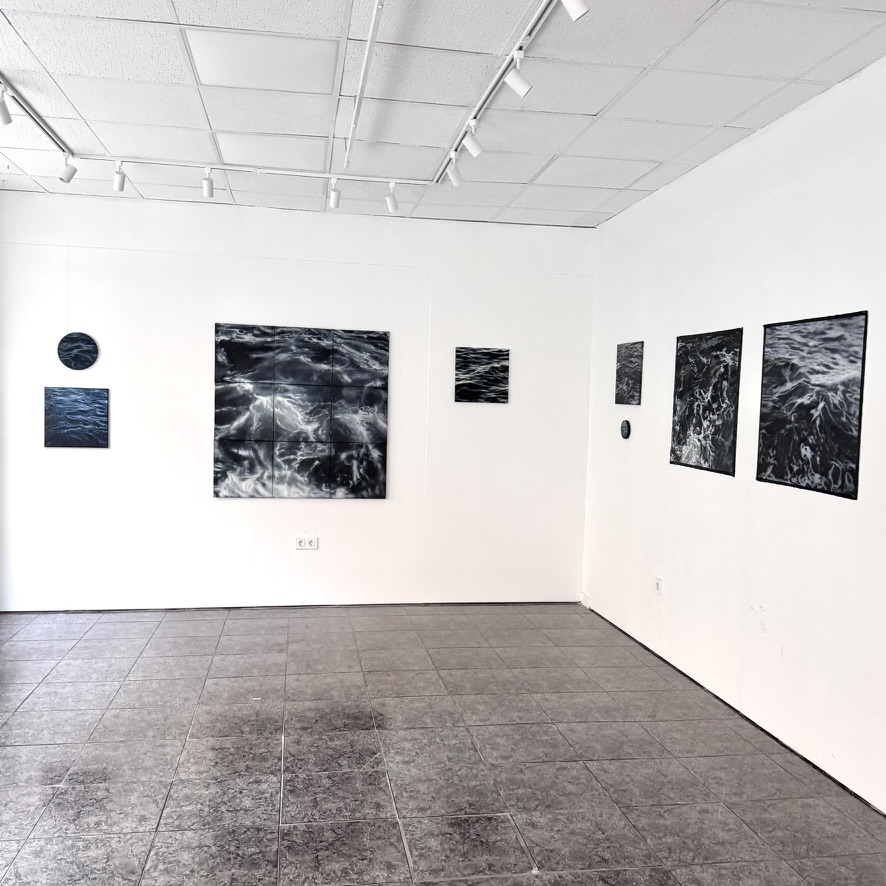
Installation view, El Mar Hirviendo, The Local AIR, Valencia, 2026.
The method I developed for the paintings came from the same problem the older traditions also solved: the sea exceeds attention. It is too large, too mobile, too information-dense to face whole. I divide the photograph into a grid and paint each square as its own abstraction, entering the uncontainable piece by piece, the way a ritual creates a container for an experience that would otherwise overwhelm.
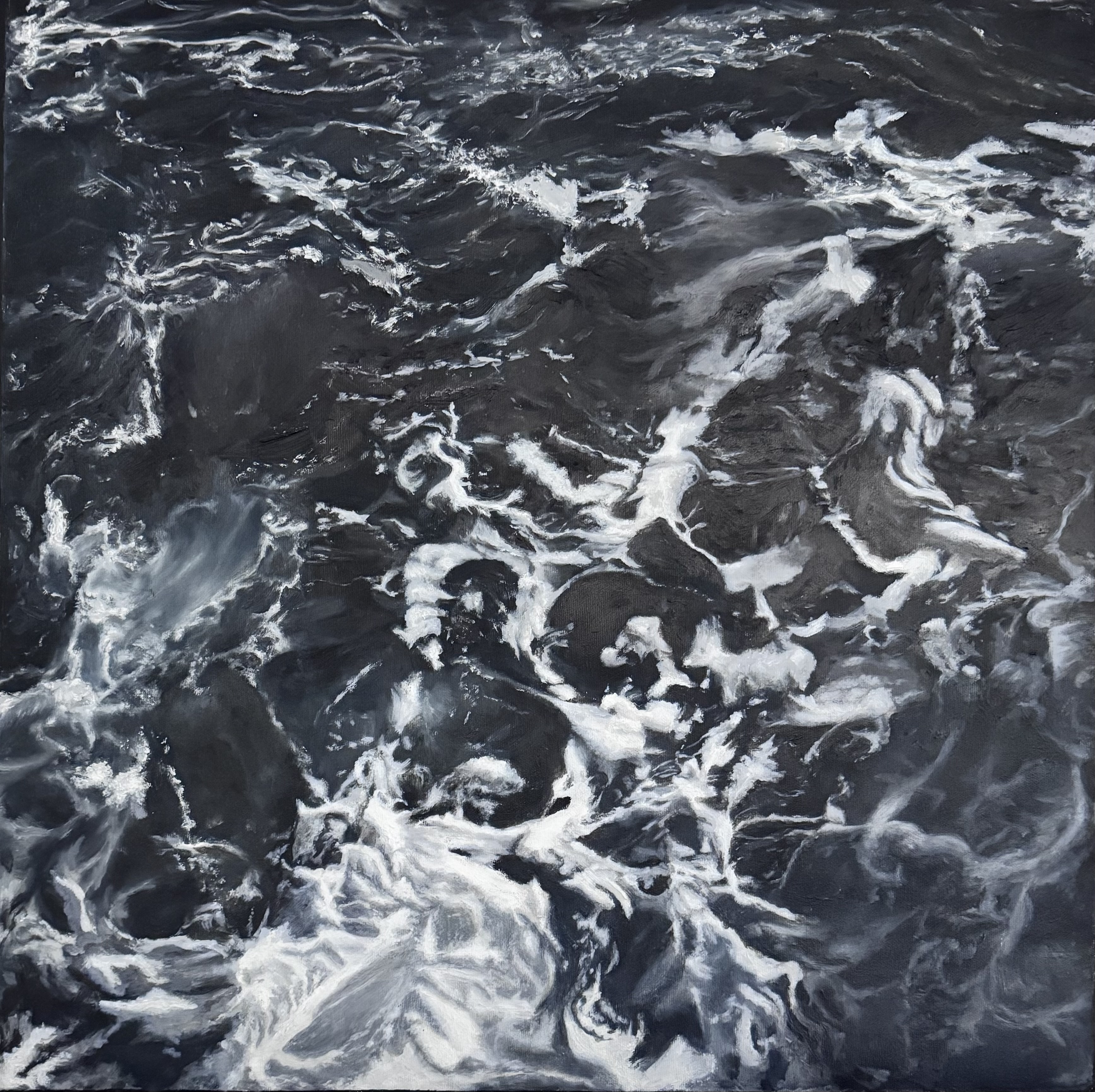
El Mar Hirviendo, oil on canvas, 70 × 70 cm, c. 2021.
The grid is a technology for approach, the same function as the drum, the offering, the ceremony. And then, as with any ritual, the technique eventually becomes the thing you have to escape: you surface from an hour inside one square to find the method has enclosed you, and you have to step back, see the whole, ask whether the painting feels like the water rather than looks like it. The judge is the body's memory of standing at the edge, not the eye's comparison to a photograph.
The work connects, I have come to think, to that older understanding of the sea as a threshold: a surface beneath which something else is happening, something that is present and active but not visible. What the painting tries to do, and what fifteen years of looking at the same surface tries to do, is stay in relation to what is underneath without pretending it can be seen or fully known. This is not mysticism. It is closer to what the Polynesian navigator does with the current, or what the Inuit shaman does with the journey downward: developing a practice that allows you to remain in contact with a force that exceeds you, and bringing back what you can.
A different relationship
The sea was here before any of the cultures that have tried to name it. It will remain after all of them. Every age teaches its people a different sea, as threat, as medicine, as resource, as paradise, as ecological wound, and in doing so shapes what that age believes about its relationship to the world. What shamanic cultures across the globe share, in their very different relationships with the sea, is not a belief system but a posture: one of reciprocity rather than ownership, negotiation rather than extraction, attentiveness to what the sea is doing rather than prescription of what it ought to look like.
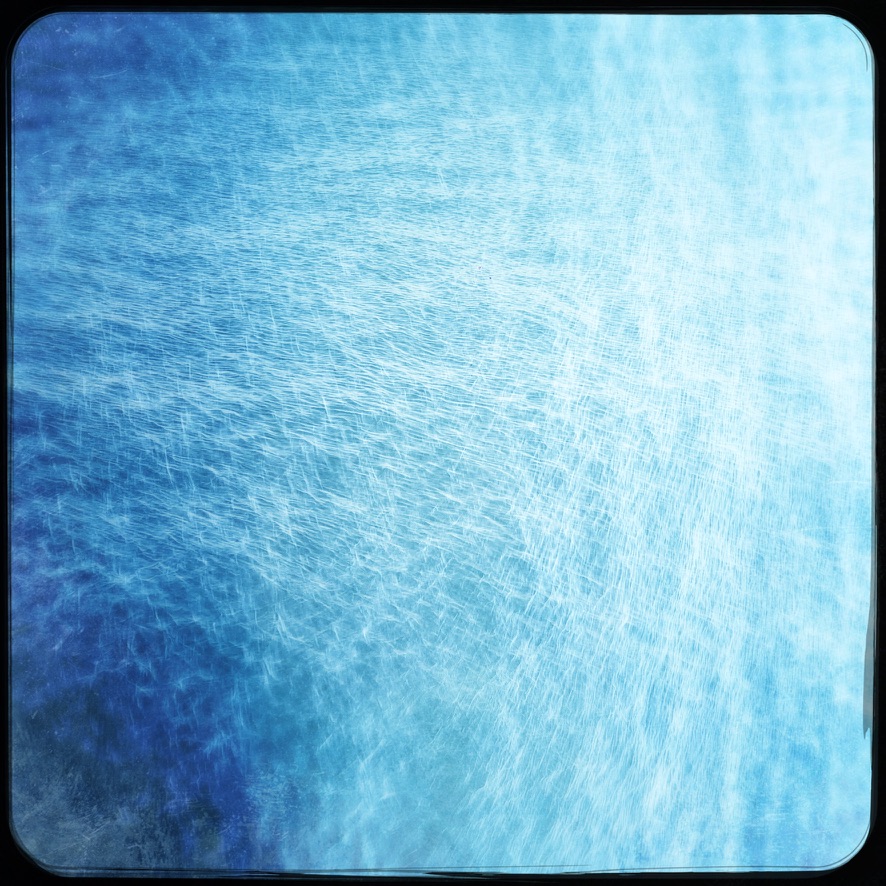
El Mar Hirviendo (double exposure), Hipstamatic photograph, 2019.
That posture is not available only to traditional practitioners. It is recoverable anywhere there is a body, a shore, and the willingness to stop looking for the postcard and start asking what is actually there. The sea has always been transmitting. Whether we are receiving is a different question — and an older one than we tend to think.
Collecting one of these works means owning a numbered digital edition recorded on the Tezos blockchain — a way to hold the piece and support the work directly, with no gatekeeper in between. The essay and the images remain free to read and to look at; collecting is entirely optional. Tezos runs on a low-energy system, so unlike some blockchains its environmental cost is minimal — which matters for work made about the sea.