
The Threshold: On the Artist as a Shaman-Like Figure
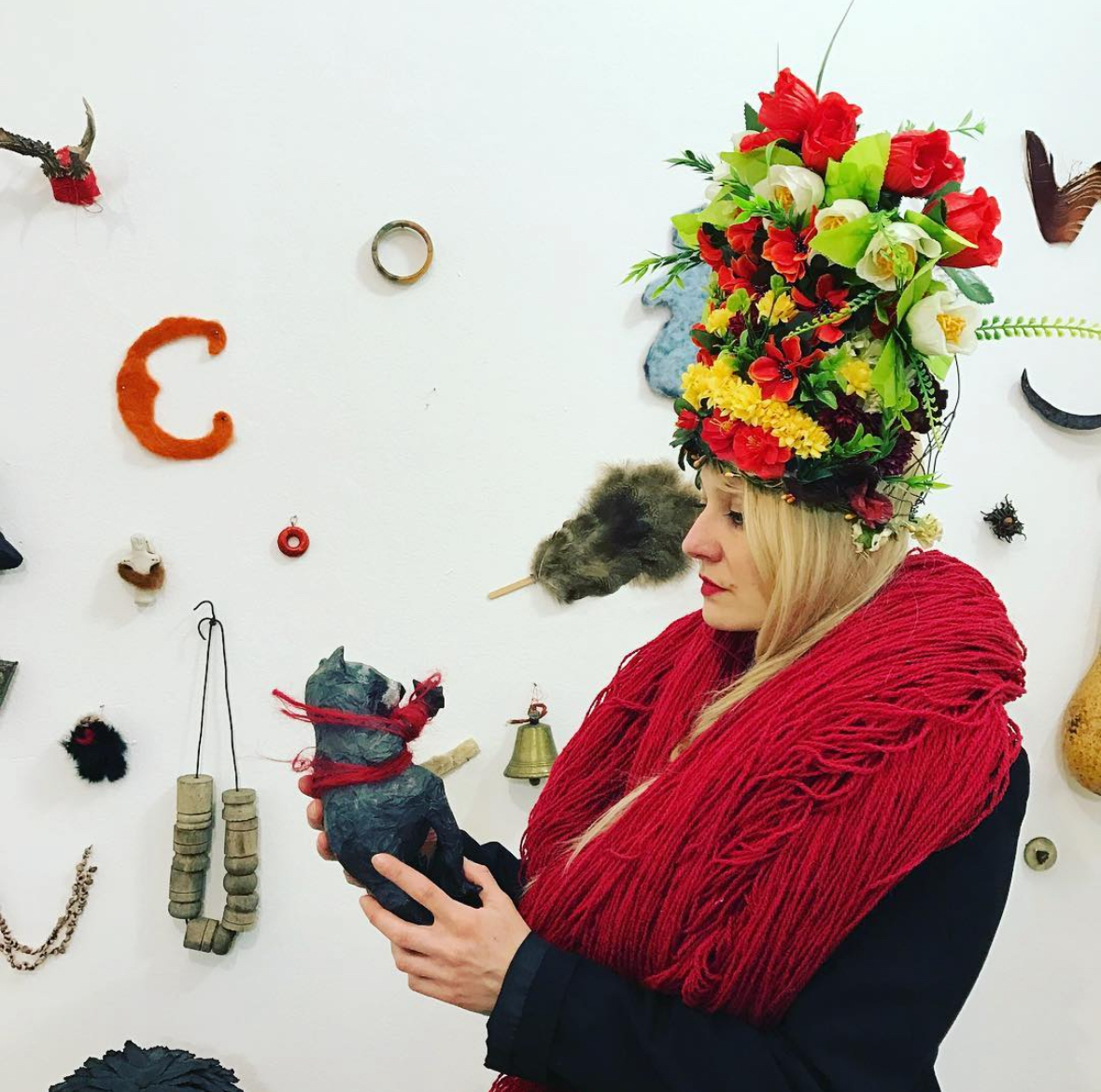
Gordana Zikic, PhD exhibition Red Deer, Belgrade, 2018
The first in a series on shamanism and contemporary art
In the house where I grew up, the invisible was part of everyday life. My grandmother read patterns — in cards, in the dark traces left at the bottom of a small coffee cup — the way other people read the newspaper: calmly, routinely, as a way of making sense of the world. No one explained or justified it, it was simply woven into the fabric of family life. It took me years to realize that this wasn't everyone's experience, that many households draw a firmer boundary between what can be measured and what can only be felt, imagined, or intuited.
What she gave me was not a belief system. It was a discipline of attention. She taught me that the world communicates through residue, pattern, and trace — through what is left behind after the main event is over — and that someone has to do the work of reading it. When she died, I had just begun my doctoral research, with not a fully formed idea yet of what it would become as my final exhibition. I had found the subject: the resemblance between two figures, the shaman and the contemporary artist. I have come to suspect she was still guiding me, that what surfaced in the work after her death was something she had planted long before.
This essay is the first of several. Over the coming articles, I want to follow that resemblance in different directions, through the work of other artists, through objects and ritual, through the sea. First, I want to begin with the resemblance itself, because once you see it, it is difficult to unsee.
Two figures, one function
It helps to begin with what a shaman actually is, beneath the cliché. The historian of religion Mircea Eliade, whose 1951 study remains foundational, argued that shamanism is not a religion but a technique — he called it an archaic technique of ecstasy — appearing on every inhabited continent, among peoples who never met. The shaman is the member of a community who can deliberately enter an altered state, travel to another order of reality, and return carrying something the community needs: knowledge, healing, orientation, balance. The anthropologist Ruth-Inge Heinze, who spent decades among living practitioners, defined the role by its functions rather than its costume: the shaman mediates between states of consciousness, serves needs that cannot be met any other way, and gives the encounter with the unseen a form the community can understand.
Read that slowly, with an artist in mind, and the border between the two begins to blur. The artist also enters states that ordinary life has no room for. The artist also goes where others cannot or will not, and returns carrying something — an image, an object, a performance — that must be given a communicable form, because a vision that cannot be transmitted helps no one. The work of art is what gets carried back across the threshold.
I have come to picture it like radio. There is not one other world but many, and each artist can catch only some of them — a particular band of a vast spectrum, the way a receiver tunes to one frequency and not the rest. What the artist makes, in whatever medium, is that frequency rendered perceptible. The ordinary person, busy with the tasks of ordinary life, has no way to tune in alone; but standing in front of the work, they receive it, the way you switch on a radio and suddenly hear music that was in the air all along. The artist is receiver and transmitter at once. This is the literal, not theatrical, sense of the word medium: a person positioned between worlds, who makes contact with another order of reality and interprets it for people living inside this one. It is precisely what the shaman has always done — reach the worlds the community cannot reach unaided, and bring something back that the rest can finally hear.
The parallel goes deeper than function. Shamans do not choose their vocation; they are called — through dreams, visions, often through illness — and in many traditions, refusing the call brings sickness, while accepting it begins a transformation into a different person with a different role in the community. Artists tend to recognize this structure immediately. Few experience making art as one career option among others; it announces itself, usually early, usually inconveniently. And most know the particular misery, psychological and sometimes physical, of the periods when they cannot work. The call does not negotiate.
Psychology even has a name for the shared capacity: transliminality, a term introduced by the researchers Michael Thalbourne and Peter Delin for a heightened permeability to material rising from the unconscious and from the environment — images, perceptions, ideas that most people filter out before they reach awareness. Both artists and shamans tend to measure high in it. It is worth saying plainly that this is a capacity, not a pathology. Studies of shamans have repeatedly described them as among the healthiest and most attentive members of their communities. The same misreading has shadowed artists for centuries. Cultures that have forgotten what the threshold is for tend to diagnose the people who can still cross it.
Not a guru
A word of caution is necessary here, because the territory attracts confusion. To call the artist a shaman-like figure is not to describe a guru, not a mystic with followers, or the charismatic center of a cult. The distinction matters and runs in the opposite direction. A cult gathers power inward, toward a leader who demands belief. The shaman, as anthropology makes clear, is the reverse: a figure without a congregation or a doctrine, who performs a service and returns the community to itself. Michael Harner, who did more than anyone to bring these practices into Western awareness, went so far as to argue that the capacity is potentially everyone's. The shaman-like artist, in the sense I mean, is not someone who asks to be believed. It is someone who opens a door and then steps out of the way.
A lineage, briefly
This is not a claim I invented. It runs through the last century of art as an actual lineage. Kandinsky was steeped in the shamanic cultures of Siberia. Joseph Beuys built his late practice openly on the figure of the shaman, insisting that in a world that speaks only in rational terms, a kind of enchanter occasionally has to appear. Marina Abramovic, who encountered Beuys as a young artist in Belgrade, carried his idea of the artist as healer into durational works that strip away everything but presence. Marcus Coates, dressed in the skin and antlers of a red deer, performed a Siberian ritual in a condemned Liverpool tower block, journeying to a lower world to bring its anxious residents an answer to a question they had genuinely asked him. Ernesto Neto has brought Amazonian healers into European museums to perform inside the white cube; Cecilia Vicuña, whose work draws on Andean cosmology, received the Golden Lion in Venice. The threshold-crossers never left, and lately they have moved back toward the center. I will return to several of them in later essays; for now it is enough to say that the position has a history, and it is not a fringe one.
Working with principles
I live in a city, not a forest; I did not inherit an unbroken tradition with its cosmology intact. This is why I think the honest term for what a contemporary artist can be is not shaman but something adjacent — shaman-like, neo-shamanic, a figure performing a comparable role under entirely different conditions. And it is why my way of working draws not on the rituals of any specific culture but on principles that recur across many of them, and that turn out to be nearly identical to the principles of art itself.
A few of these: that all beings and materials belong to one web, so that any object may carry memory or energy; that ritual gives form to invisible processes through gesture, repetition, and offering; that the elements — and the empty space left for what cannot be named — bring balance to a composition; that objects are chosen for their resonance rather than their value; that imperfection and impermanence are part of the beauty, the quality the Japanese call wabi-sabi; that arrangement is itself meaning, the placement of a central form, the weight given to empty space. None of this belongs to any single people. It is closer to a shared human grammar for relating to the unseen — and it is also, almost exactly, the grammar an artist already uses when composing anything at all. When a specific source does enter my work — an old rain rite, a figure from a tomb, a deer cult older than any church — it is never reproduced. The underlying principle is taken up and transformed by the means of art into something that did not exist before. That transformation is the whole of the work.
The gallery as temple
My doctoral exhibition, shown in Belgrade in 2018, was where this method first became a whole environment. I turned the gallery into a temple.
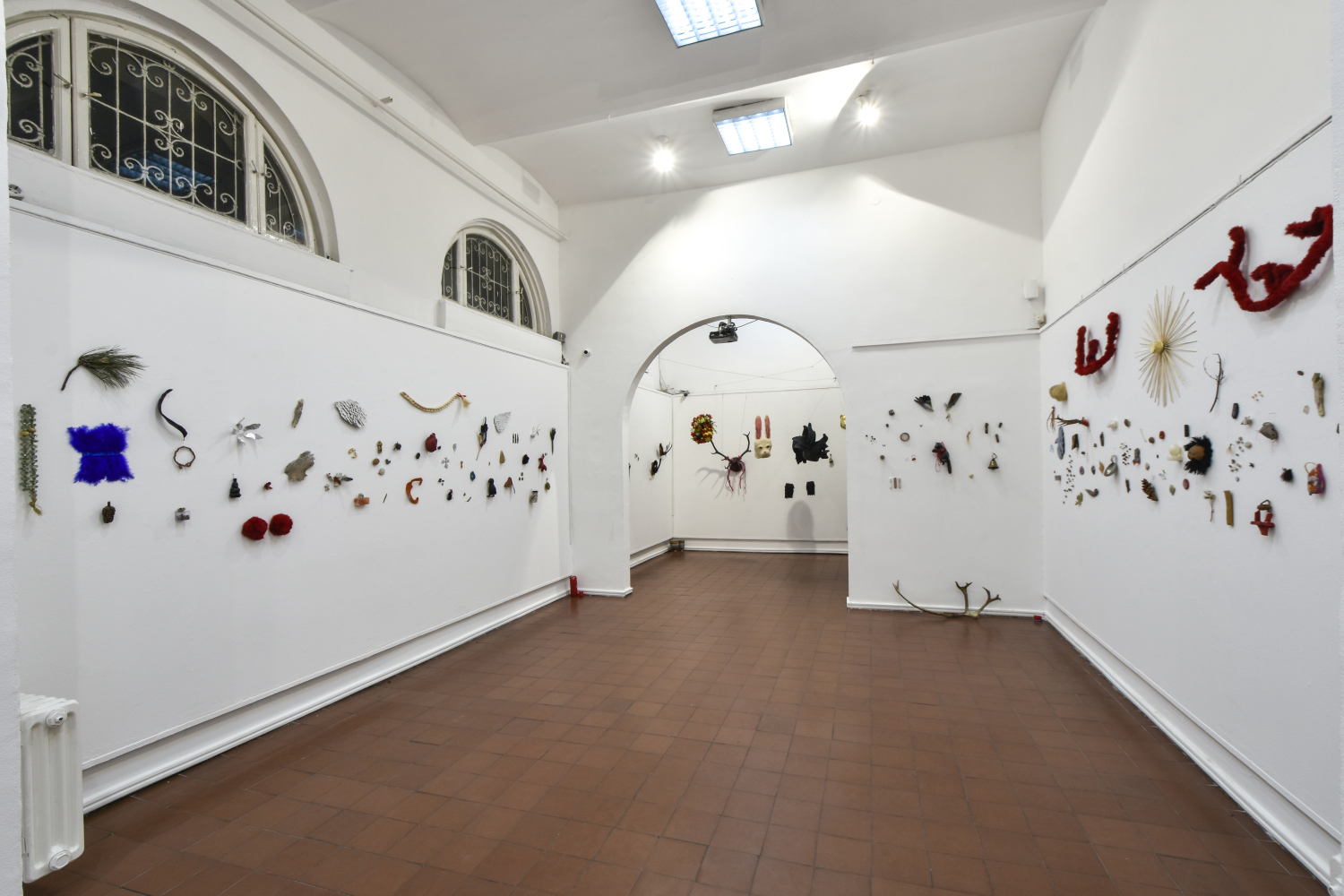
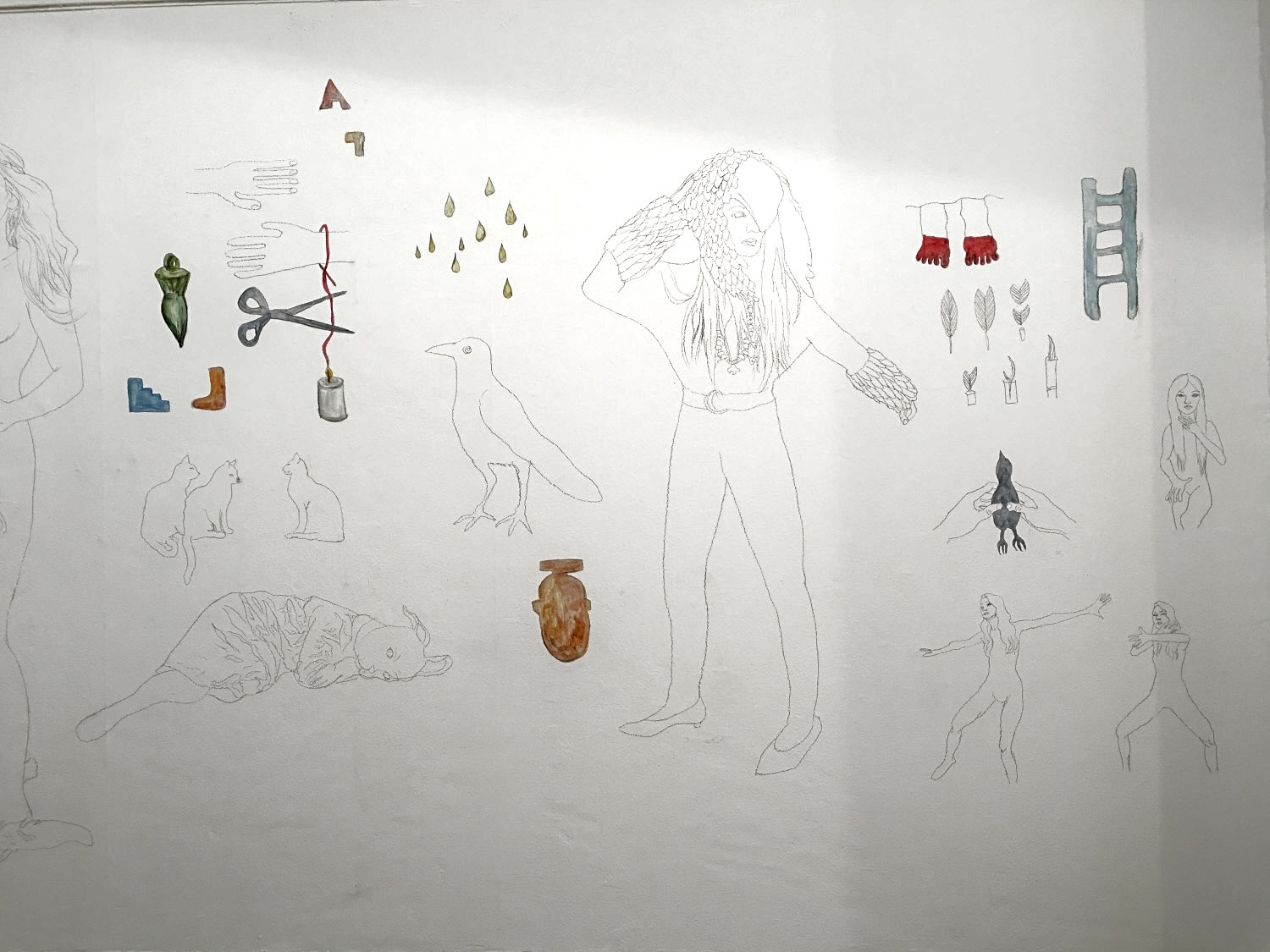
Charcoal and watercolour figures were drawn directly onto the walls, without background or perspective, so that the white of the wall became infinite space — the same logic by which the interior of a church is built to dissolve its own boundaries. When the exhibition closed, the drawings were painted over and lost. The impermanence was deliberate. A crossing is not meant to last.
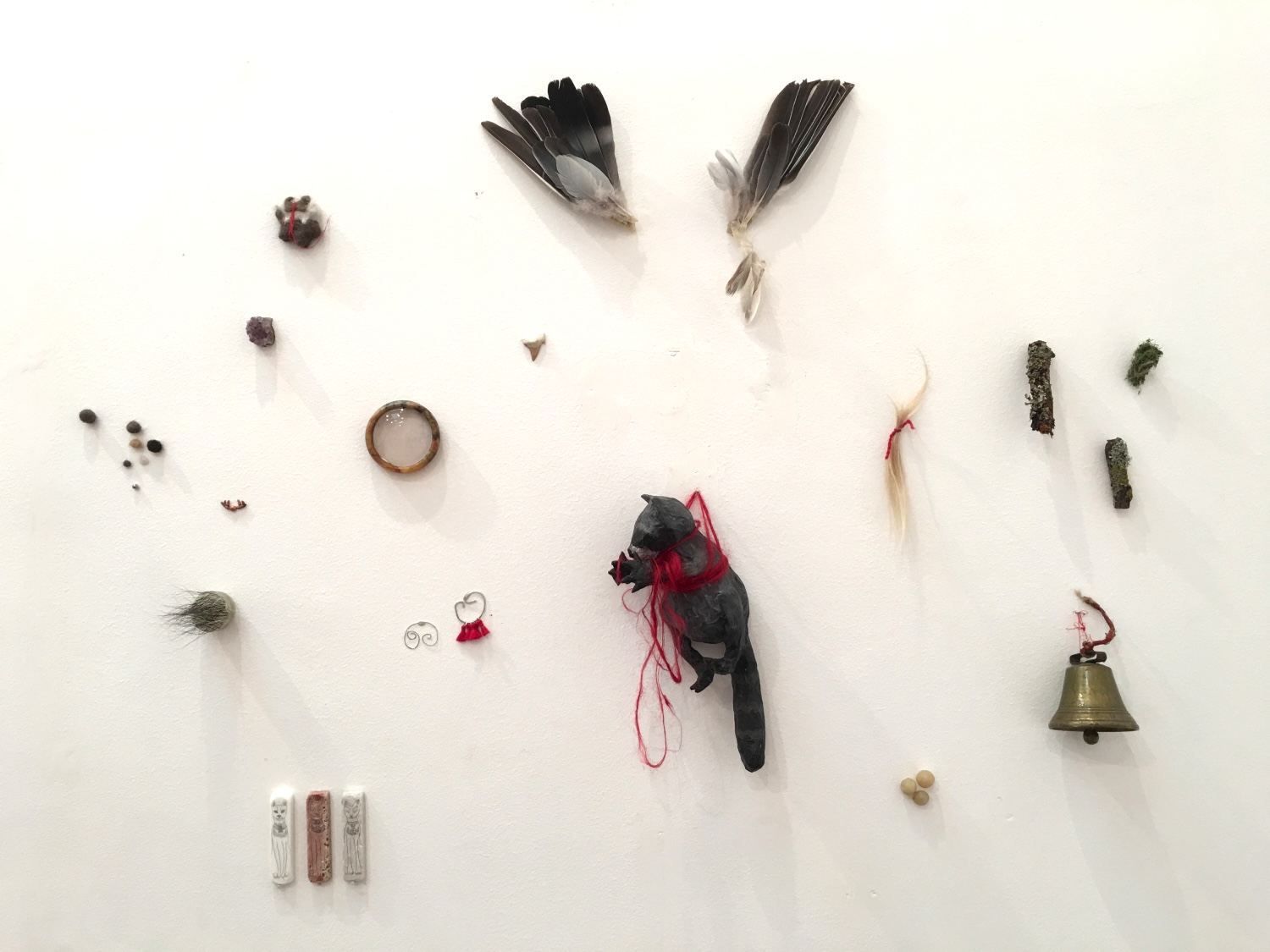
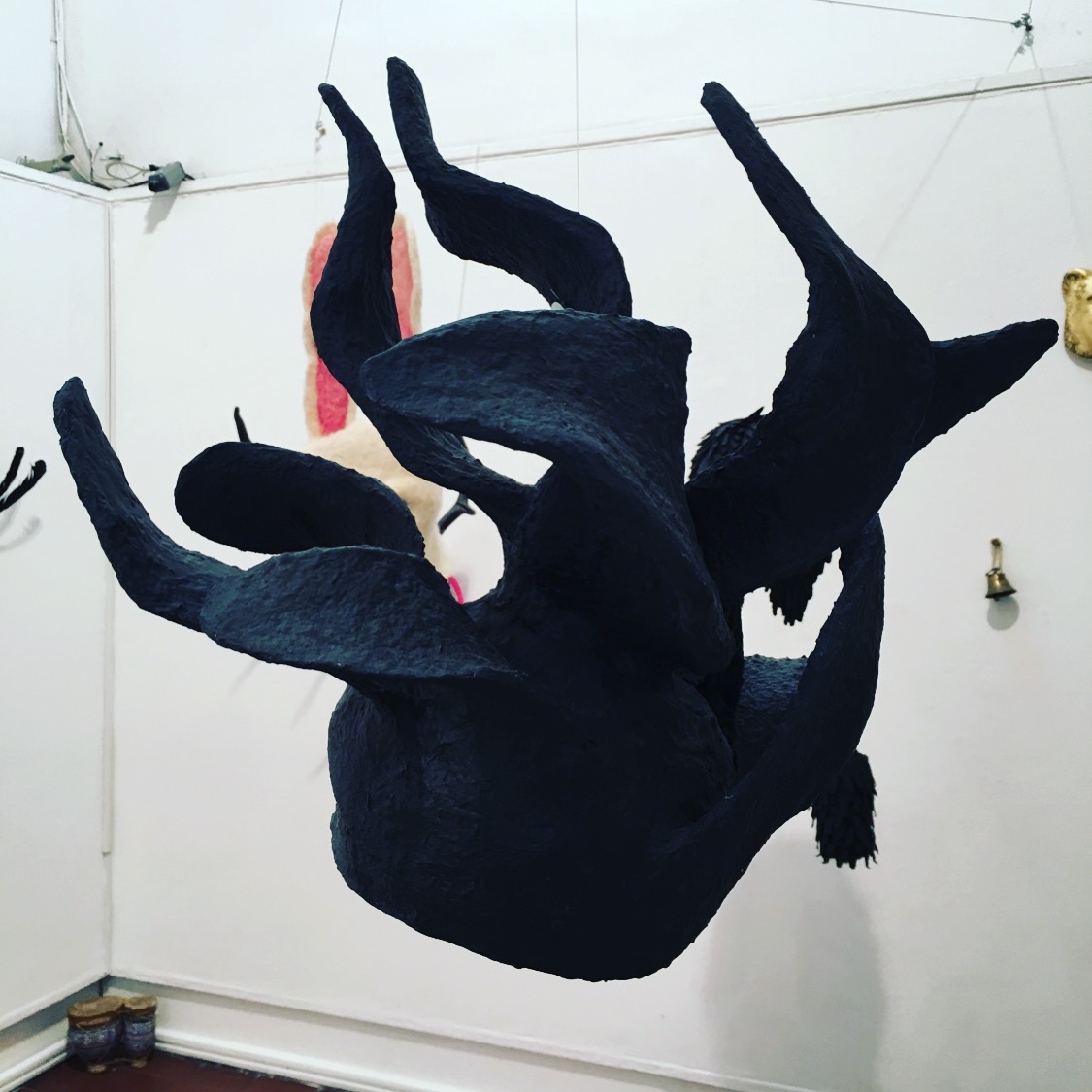
Among the drawings hung an installation of objects gathered during life — small sculptures, papier-mâché, copper wire, antlers, feathers, shells, minerals, my own hair in the colours of different years, the combed-out then felted fur of my cats. Ordinary things transformed and placed with intention become what older cultures would call sacred objects, containers of presence and memory. Visitors feel the change without needing a word for it.
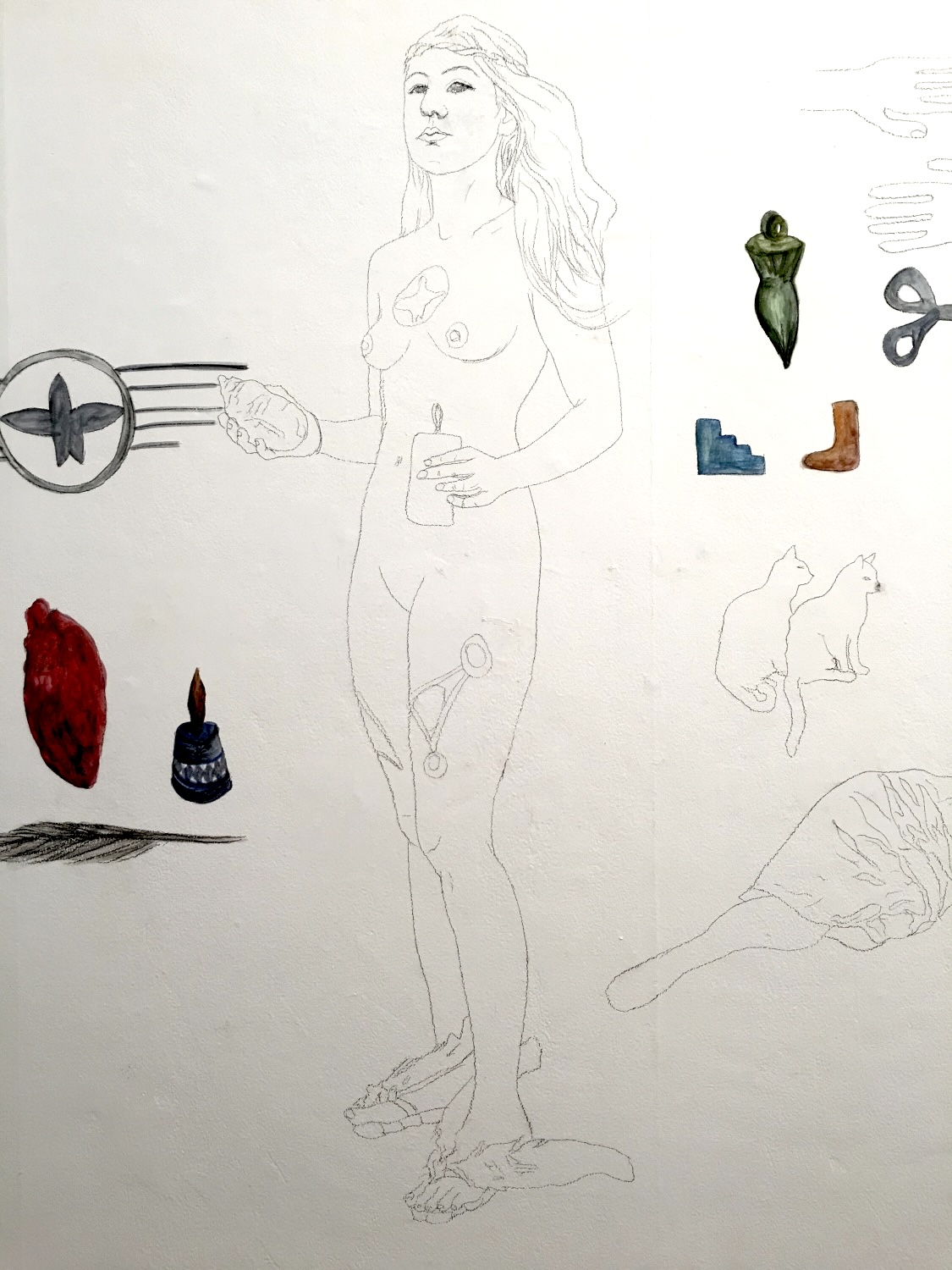
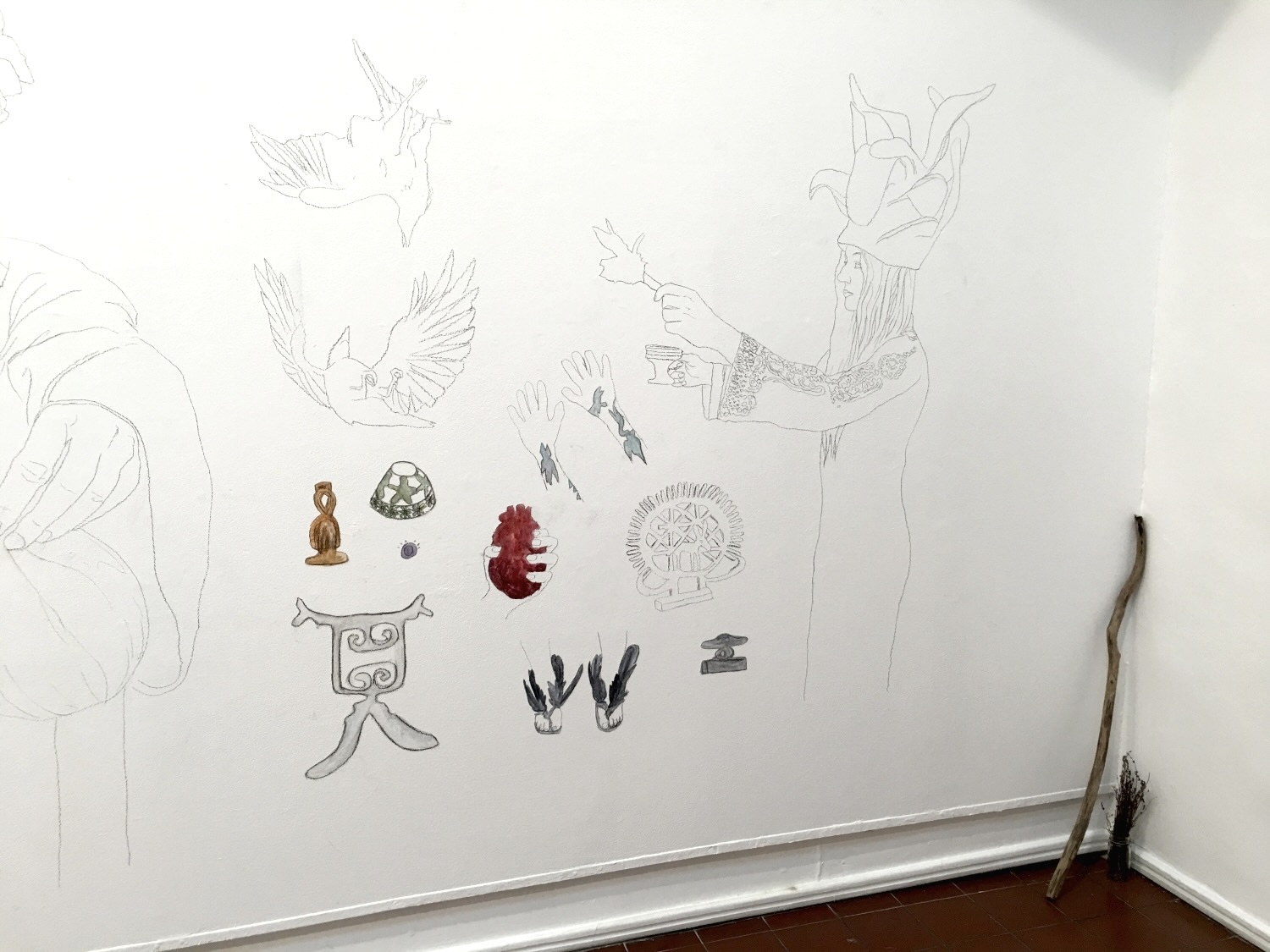
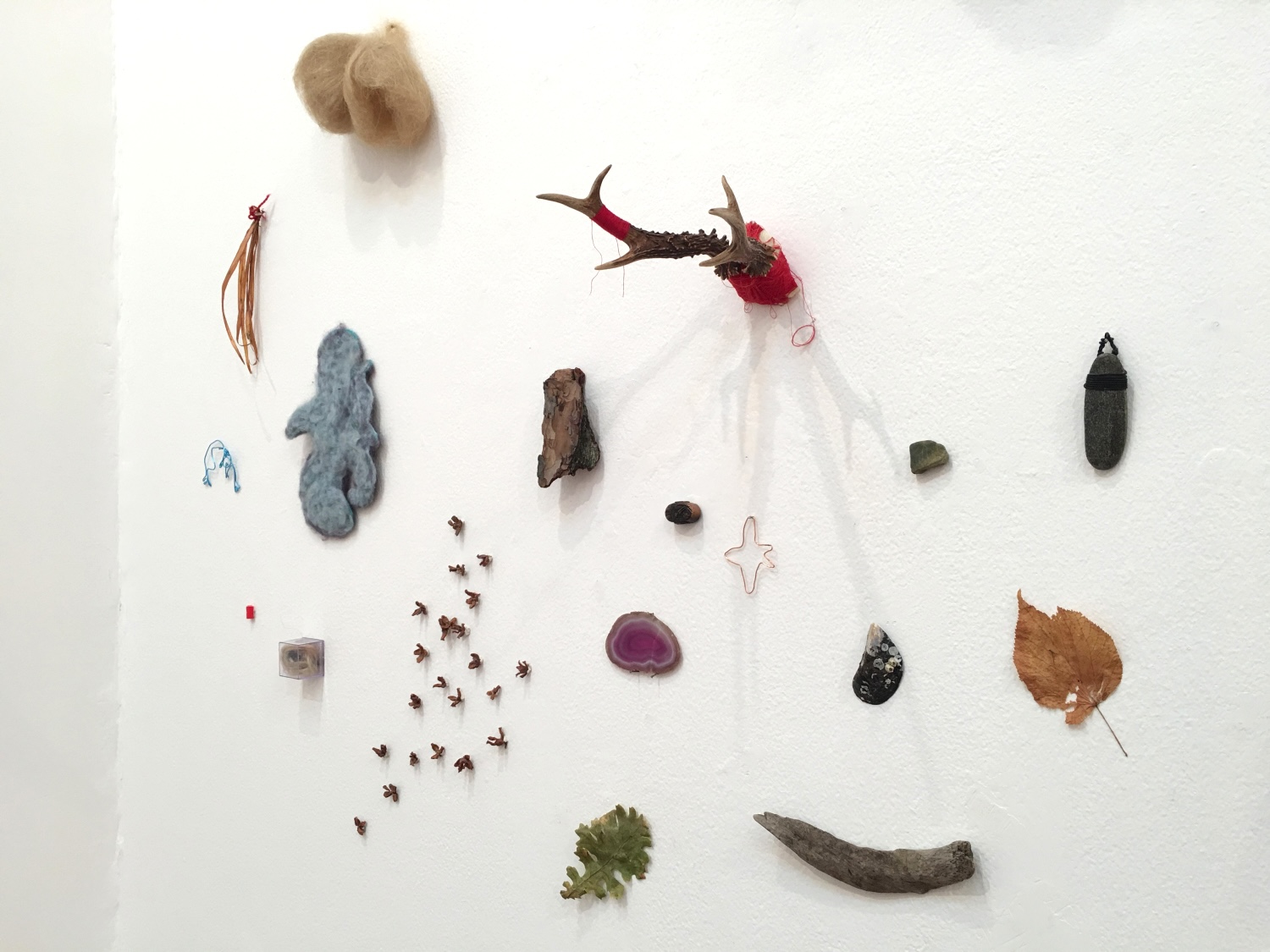
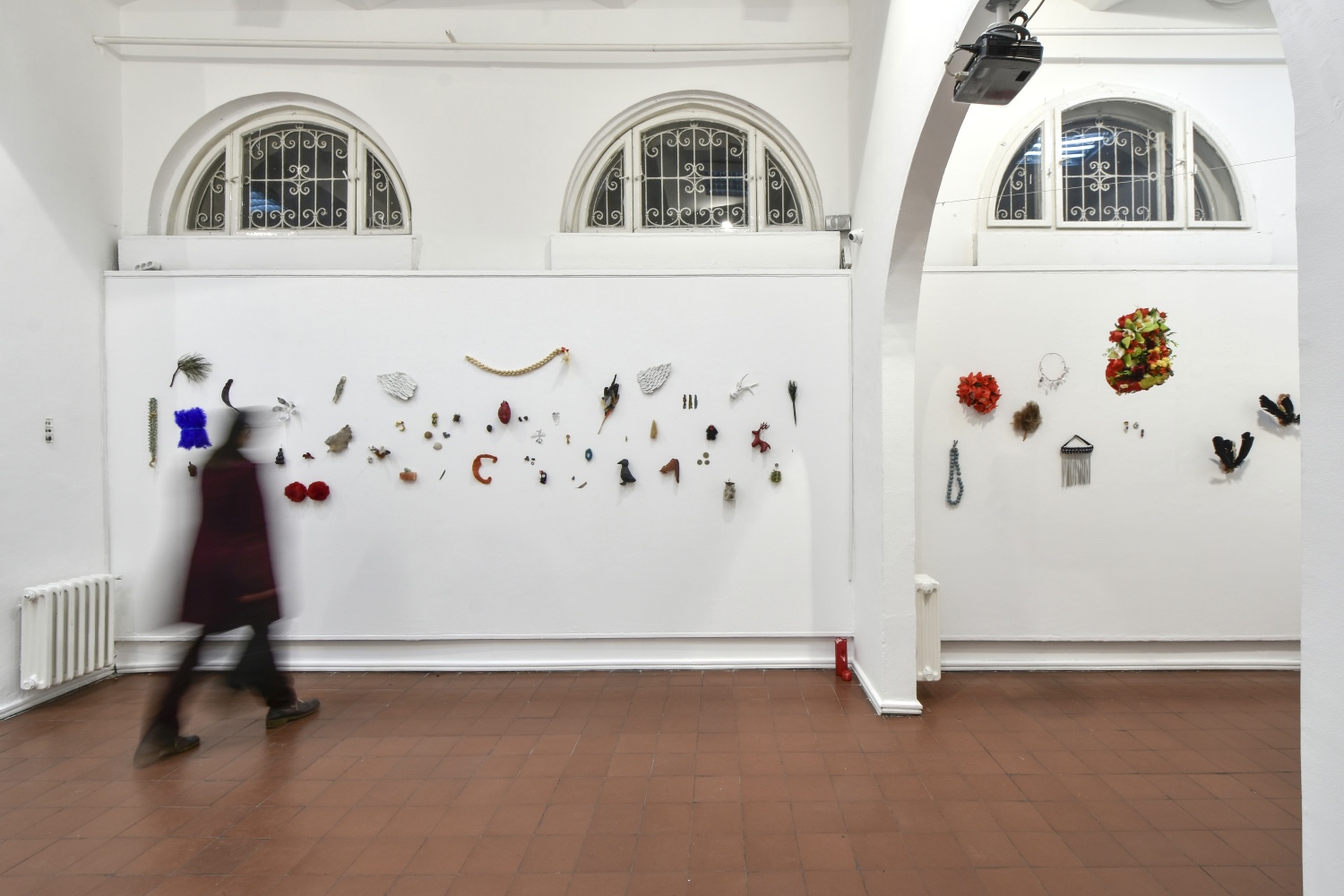
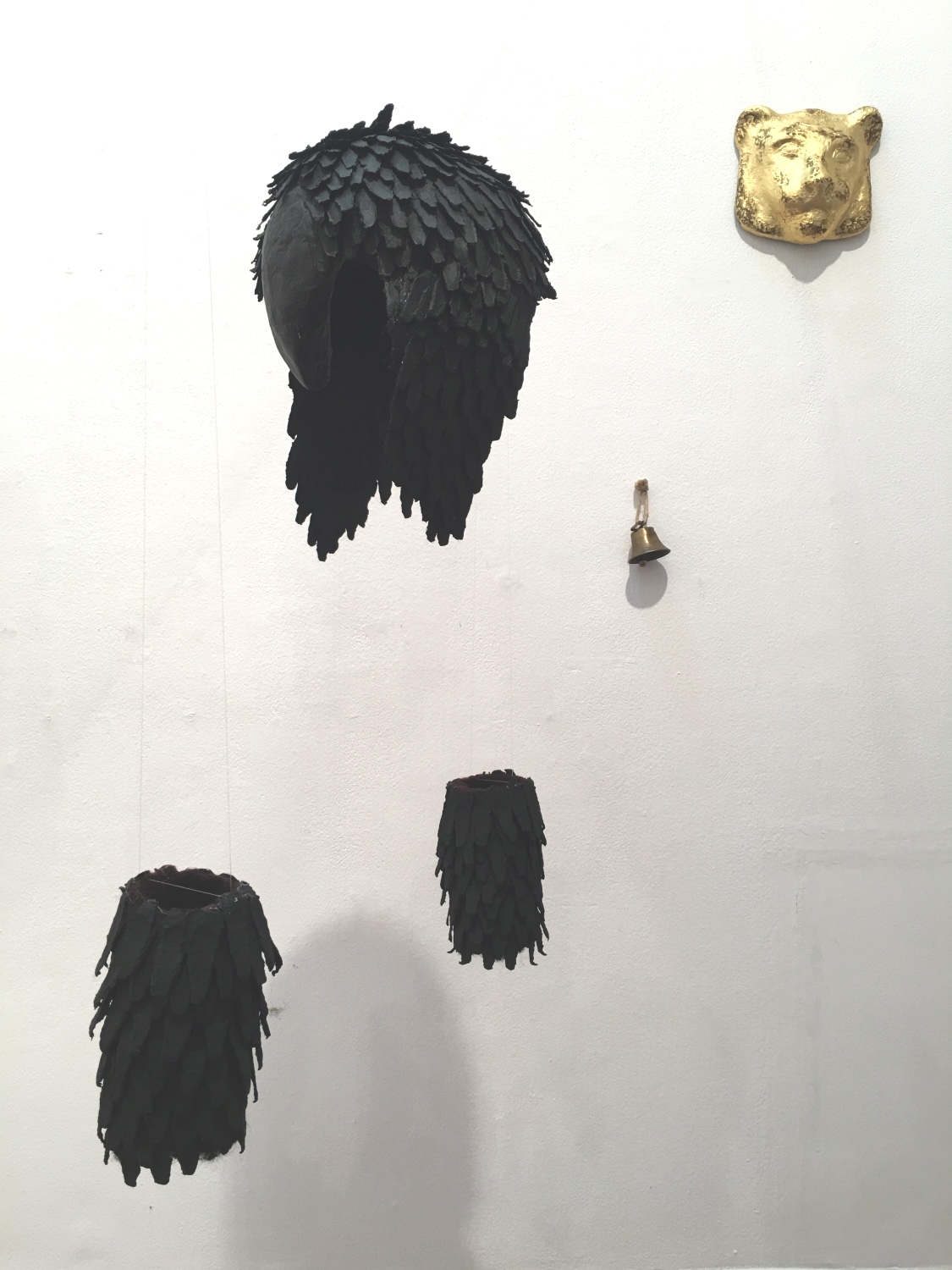
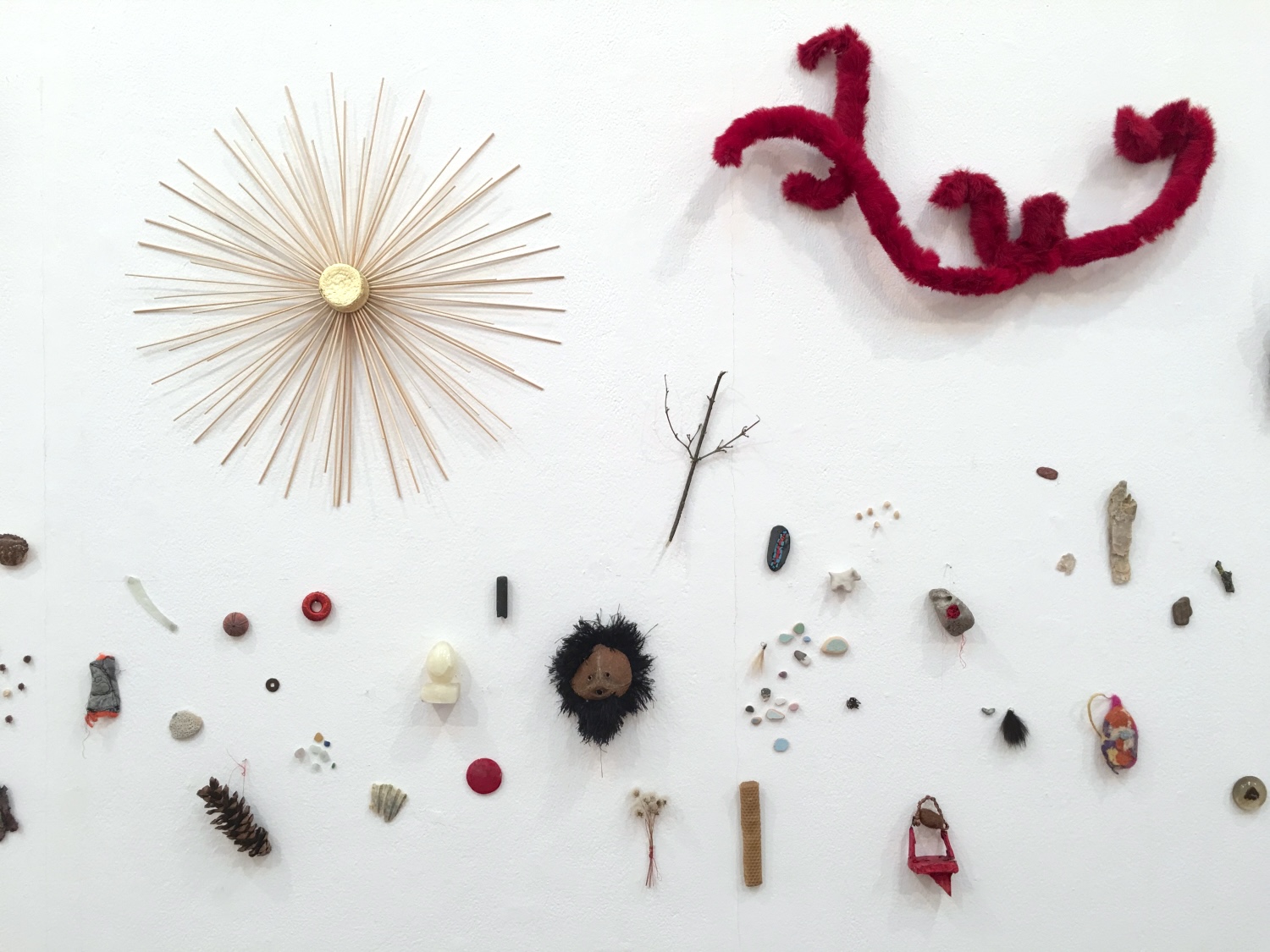
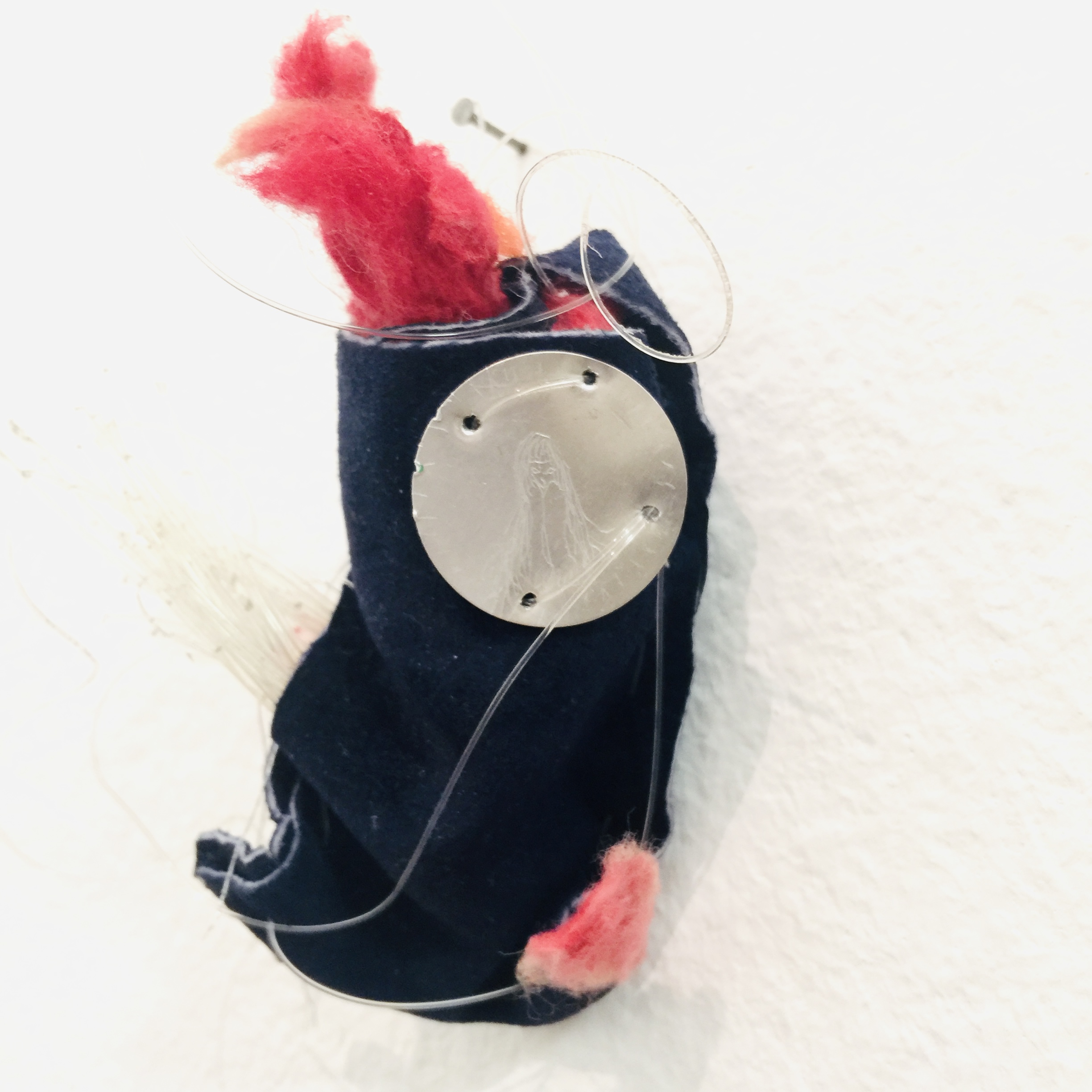
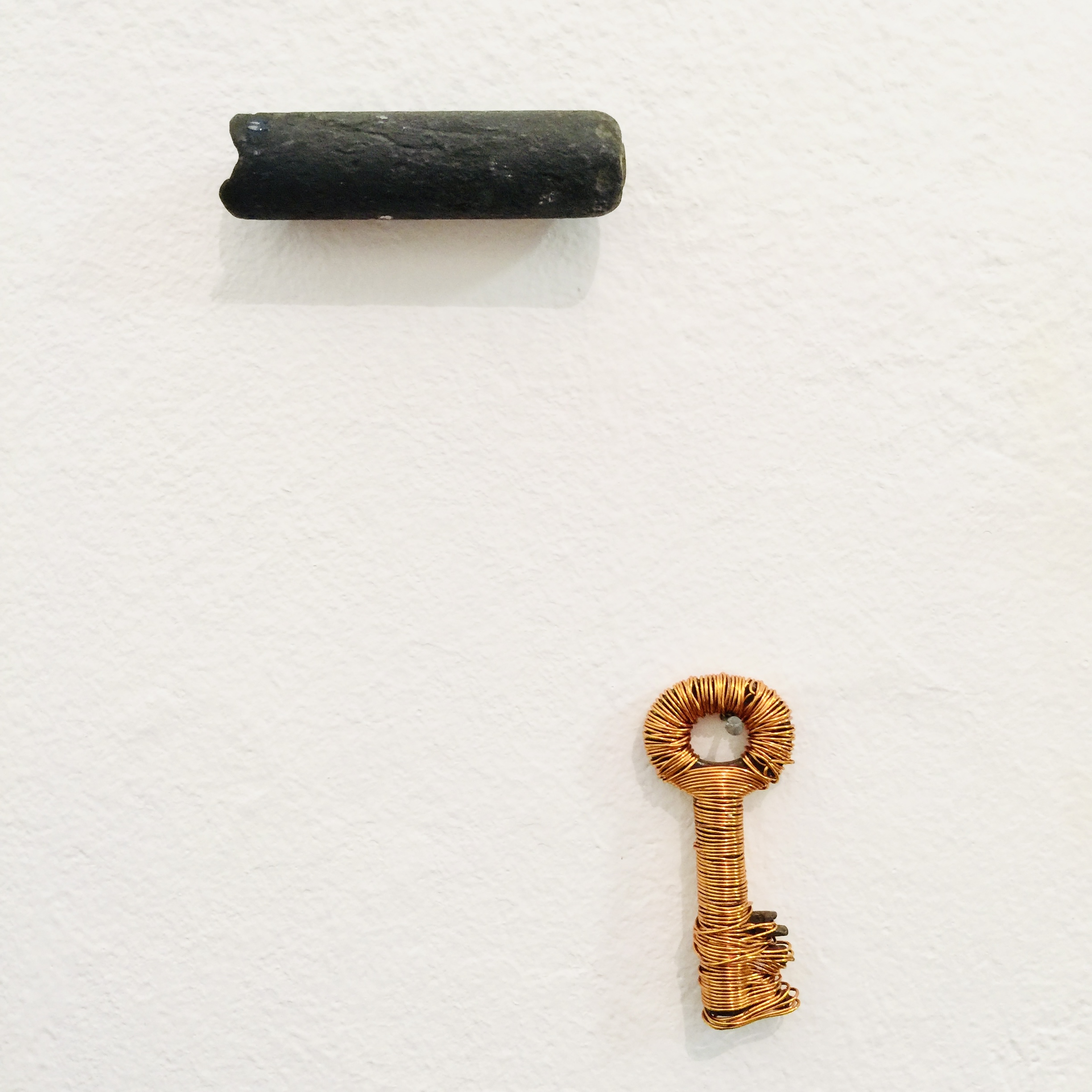
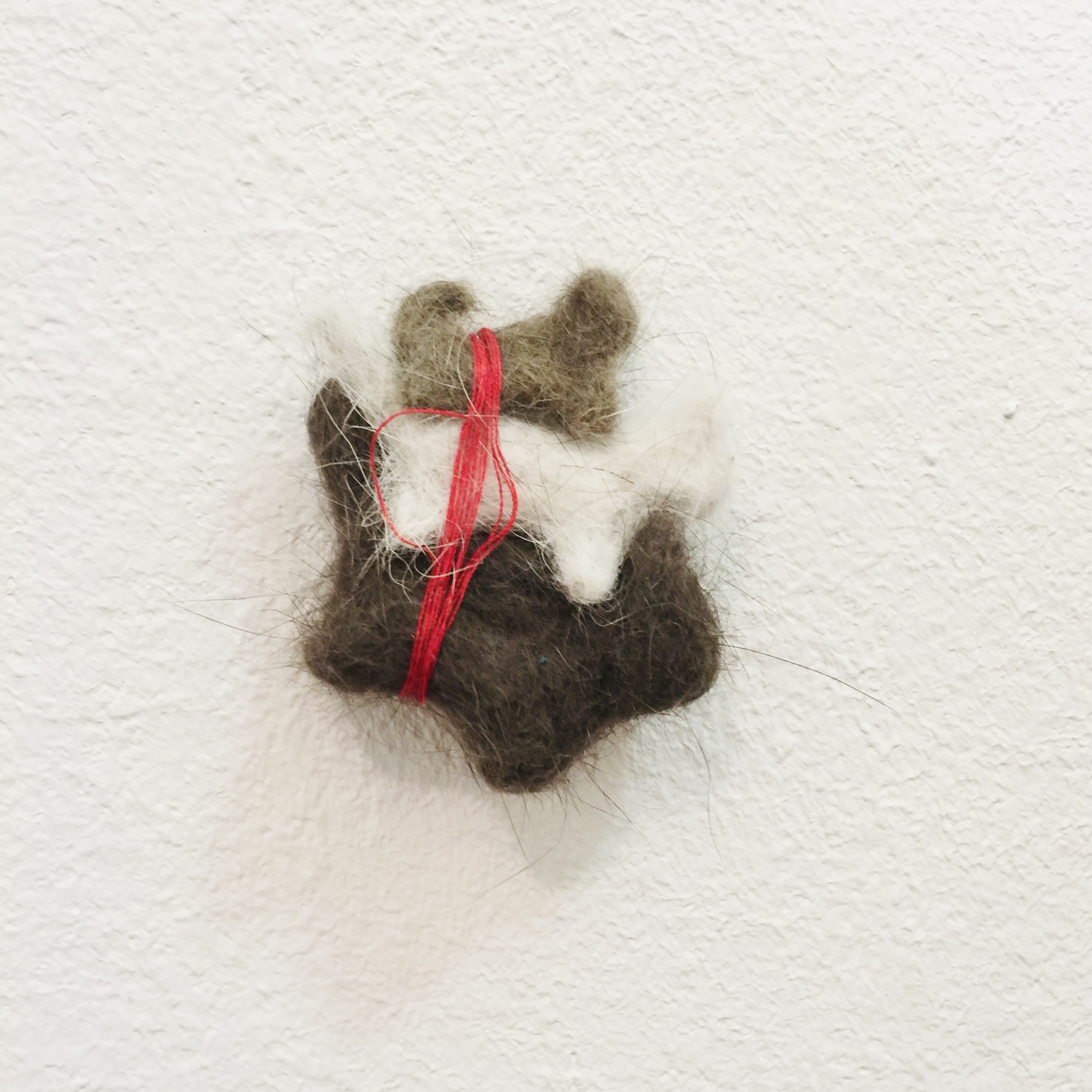
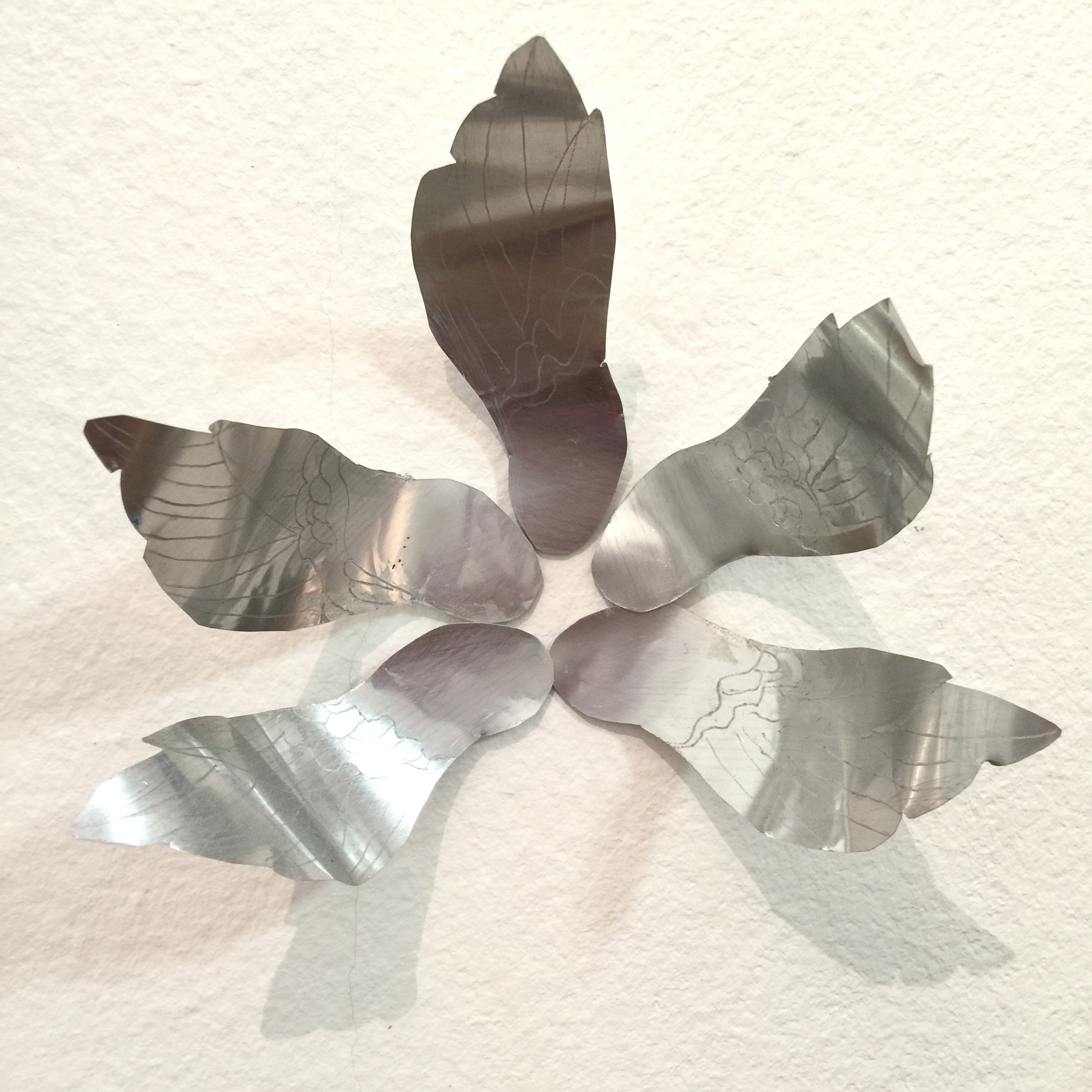
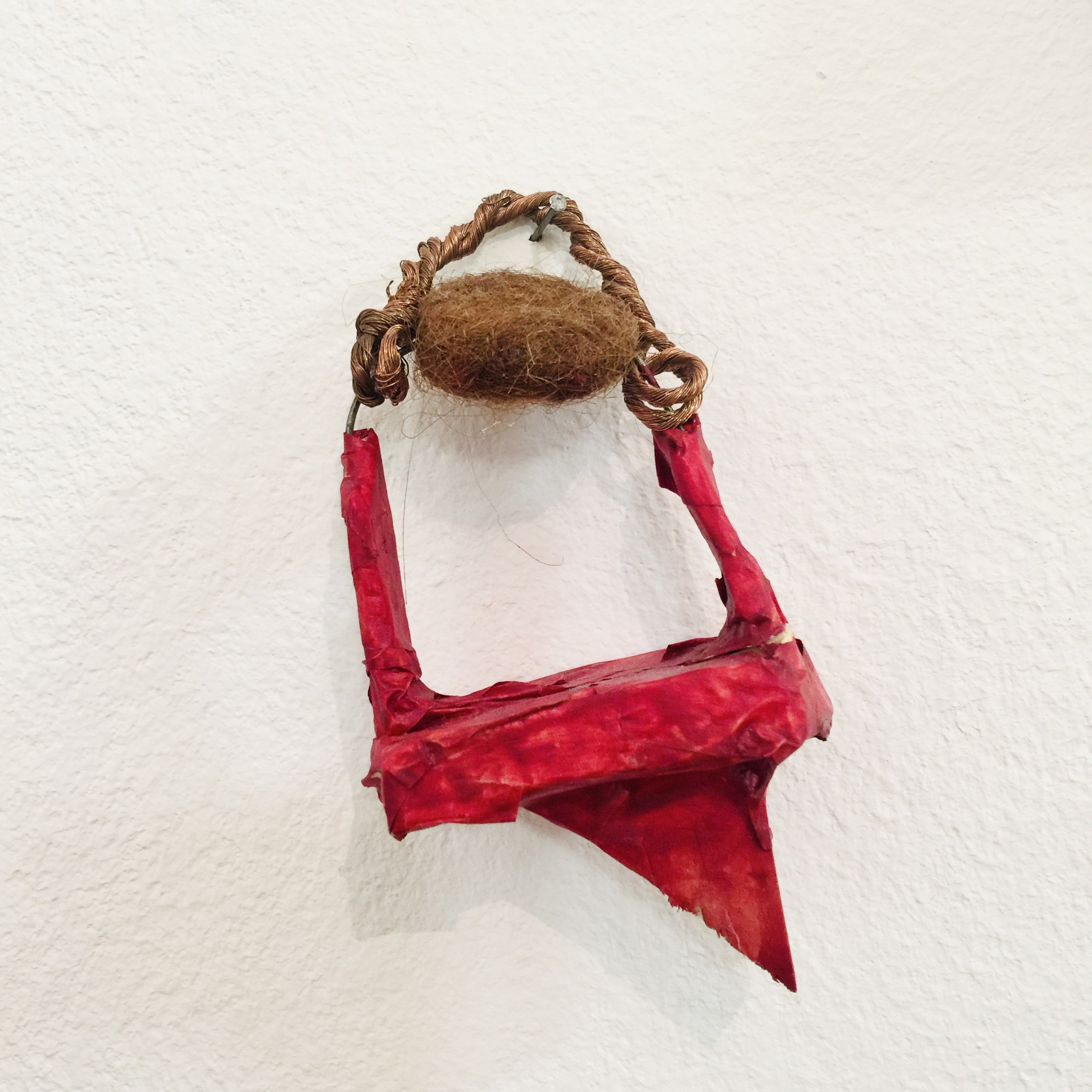
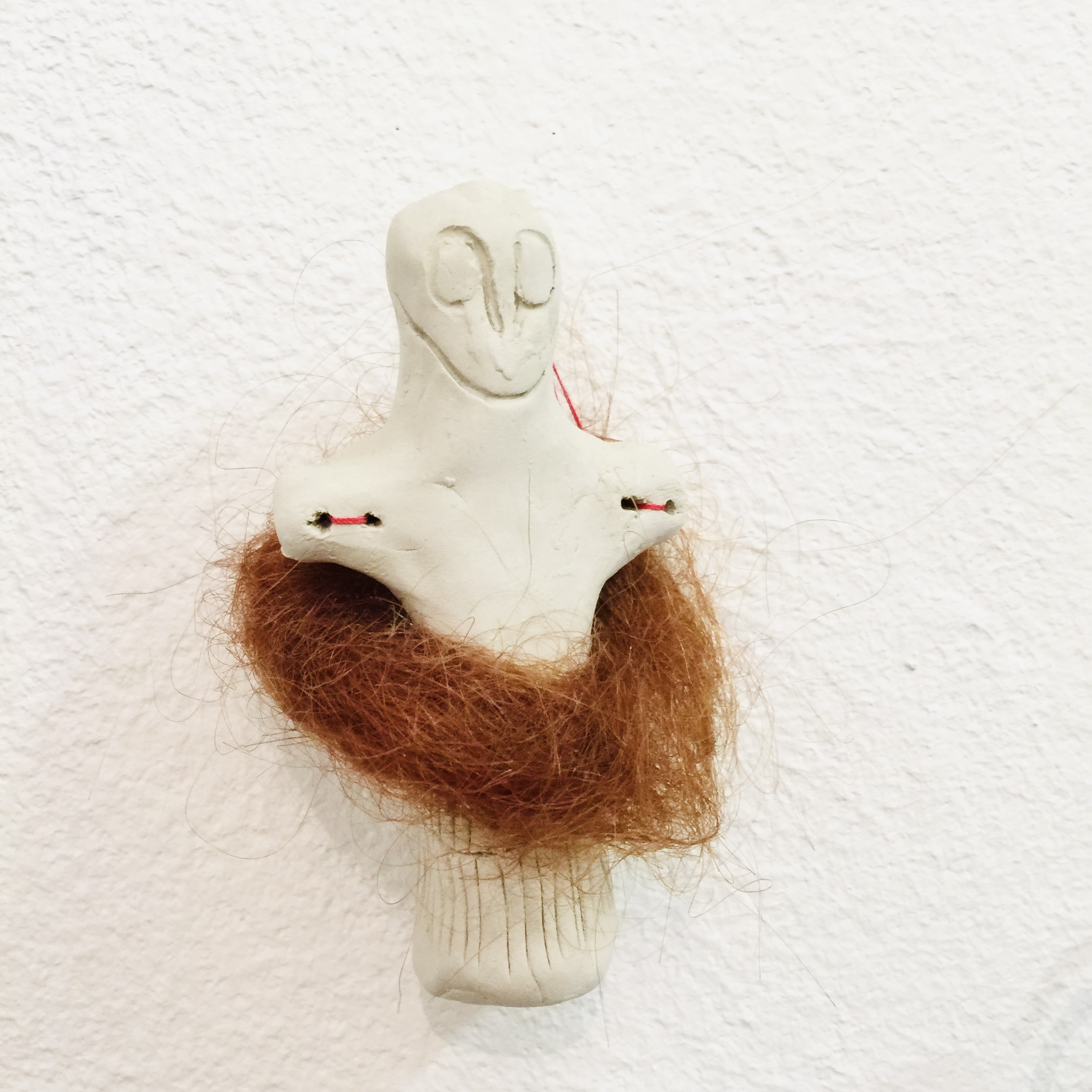
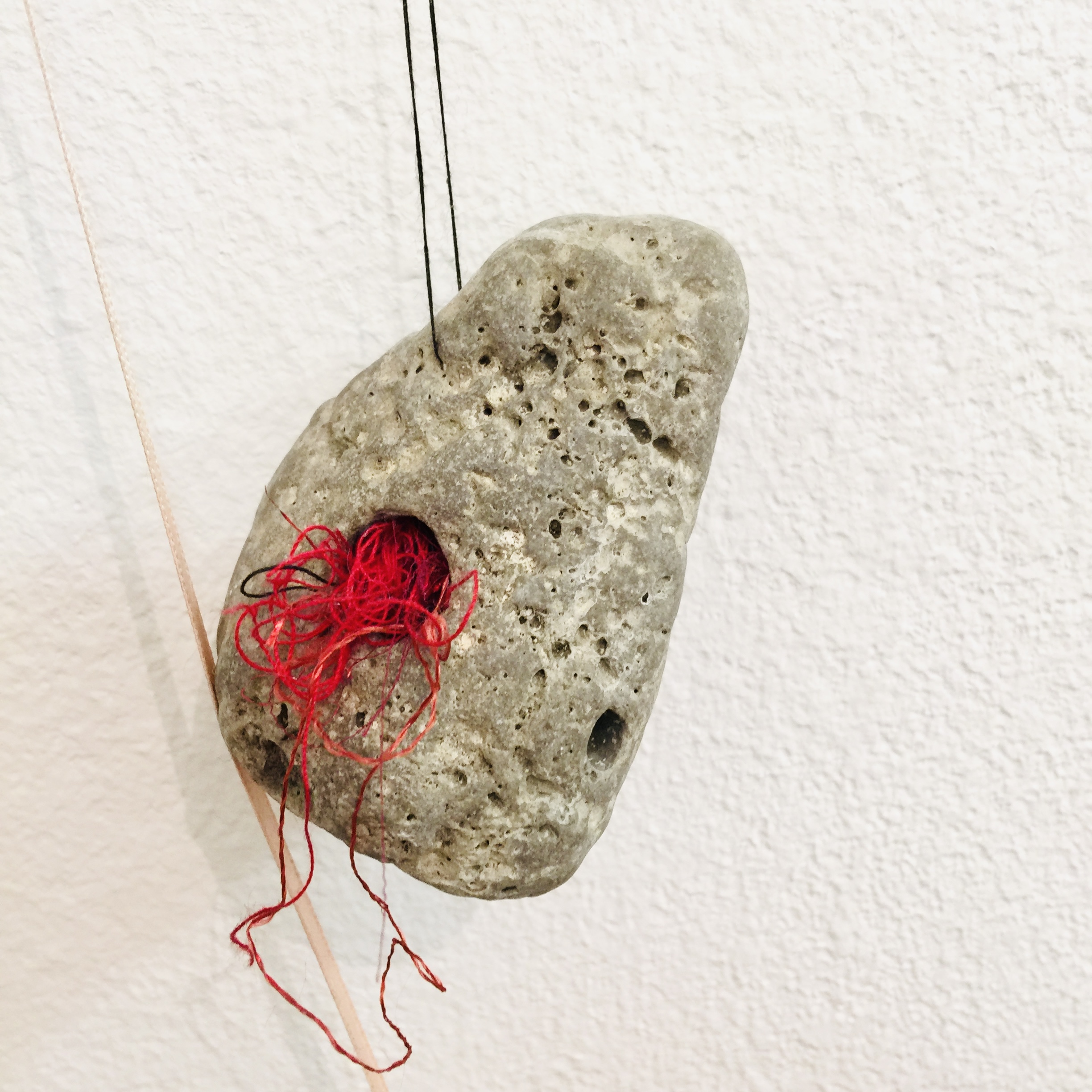
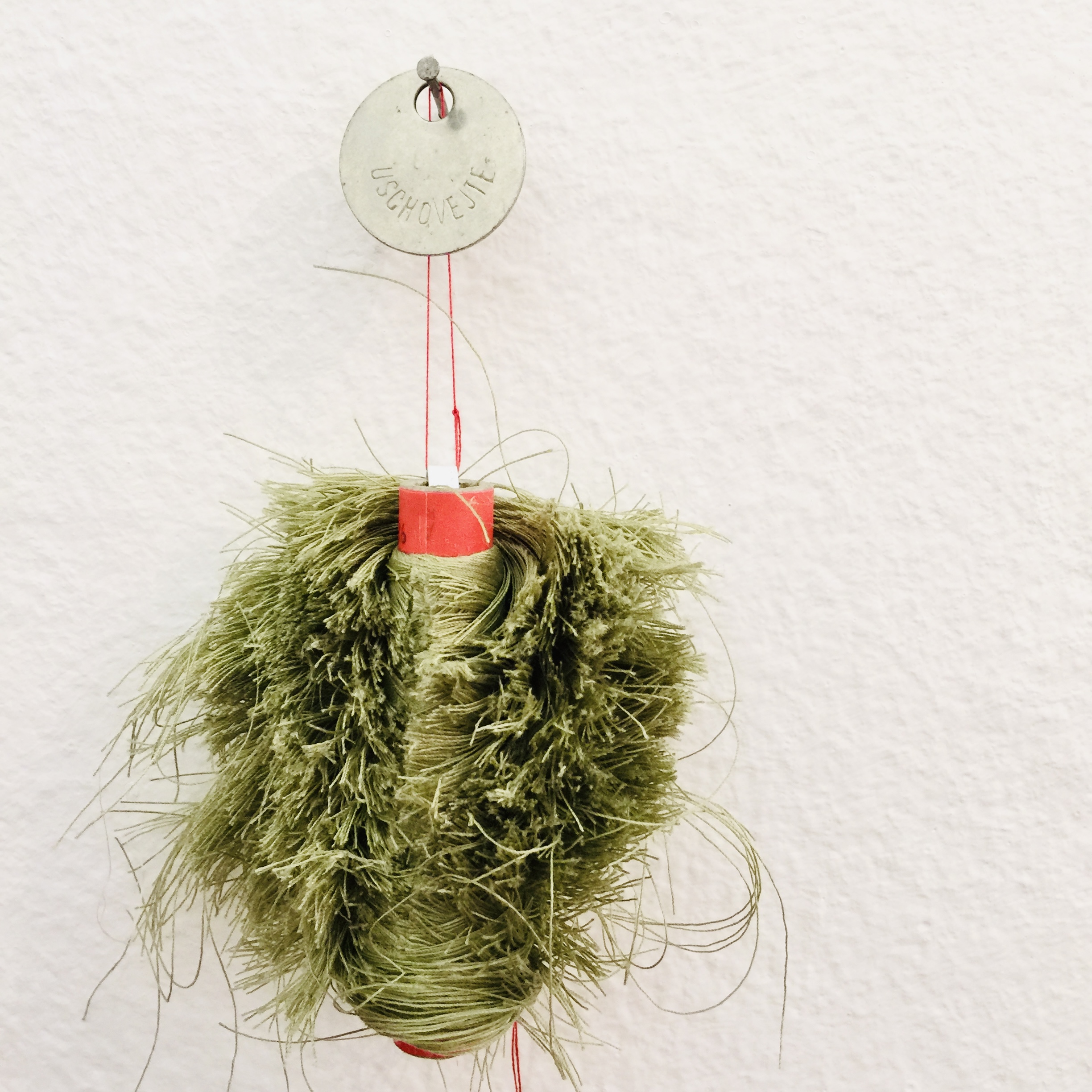
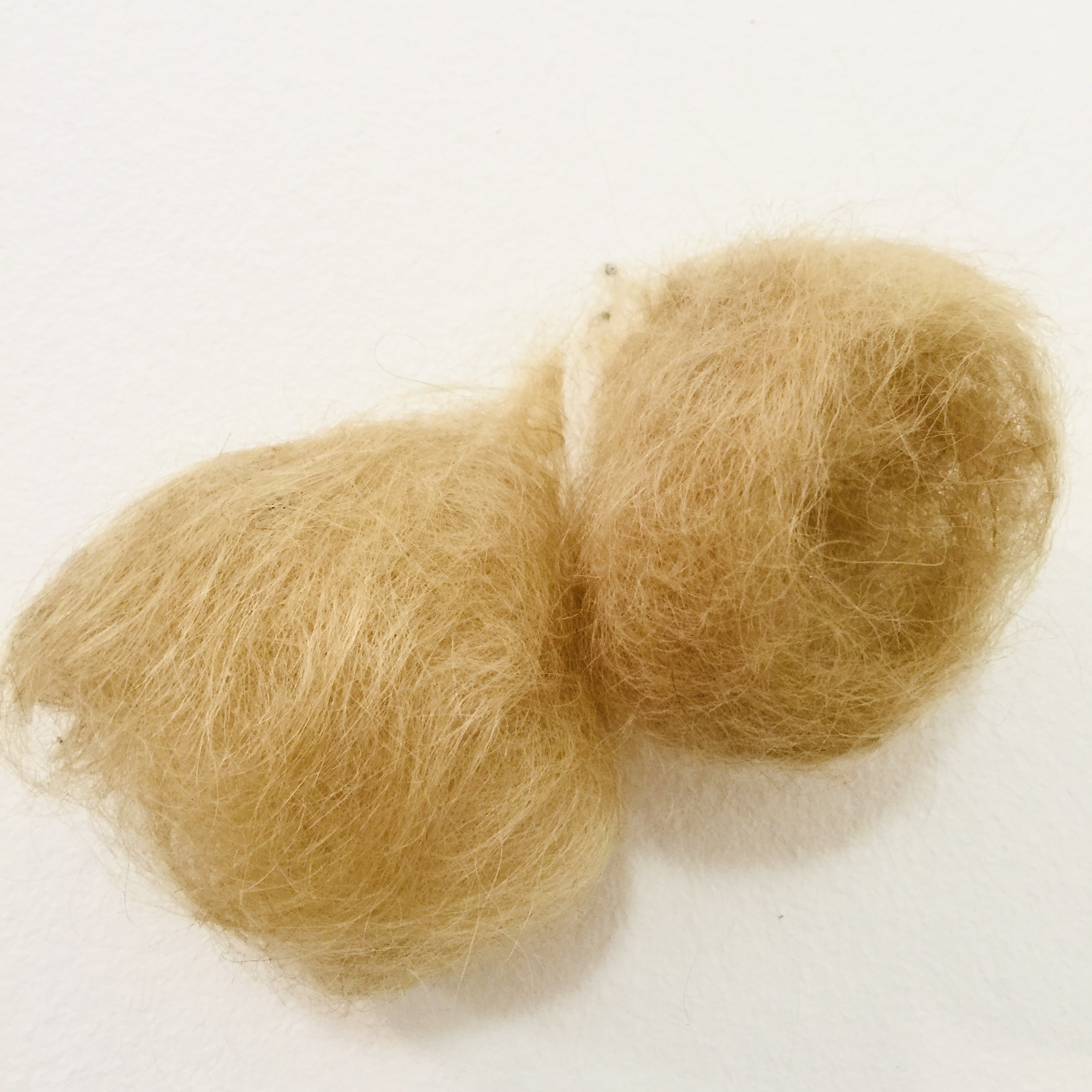
Studying the philosophy of the Chinese garden, I found a way of thinking about the deliberate framing of reality — how a window, a round doorway, can teach the eye to see what it would otherwise walk past, so that the ordinary turns strange and visible again. The garden does it with borrowed views; the gallery can do it with drawing, object, and the weight of empty space. It is only one tool among many. But it serves the larger purpose: to slow the visitor down, to change the frequency at which they are receiving, so that what the rest of the work transmits can actually be heard.
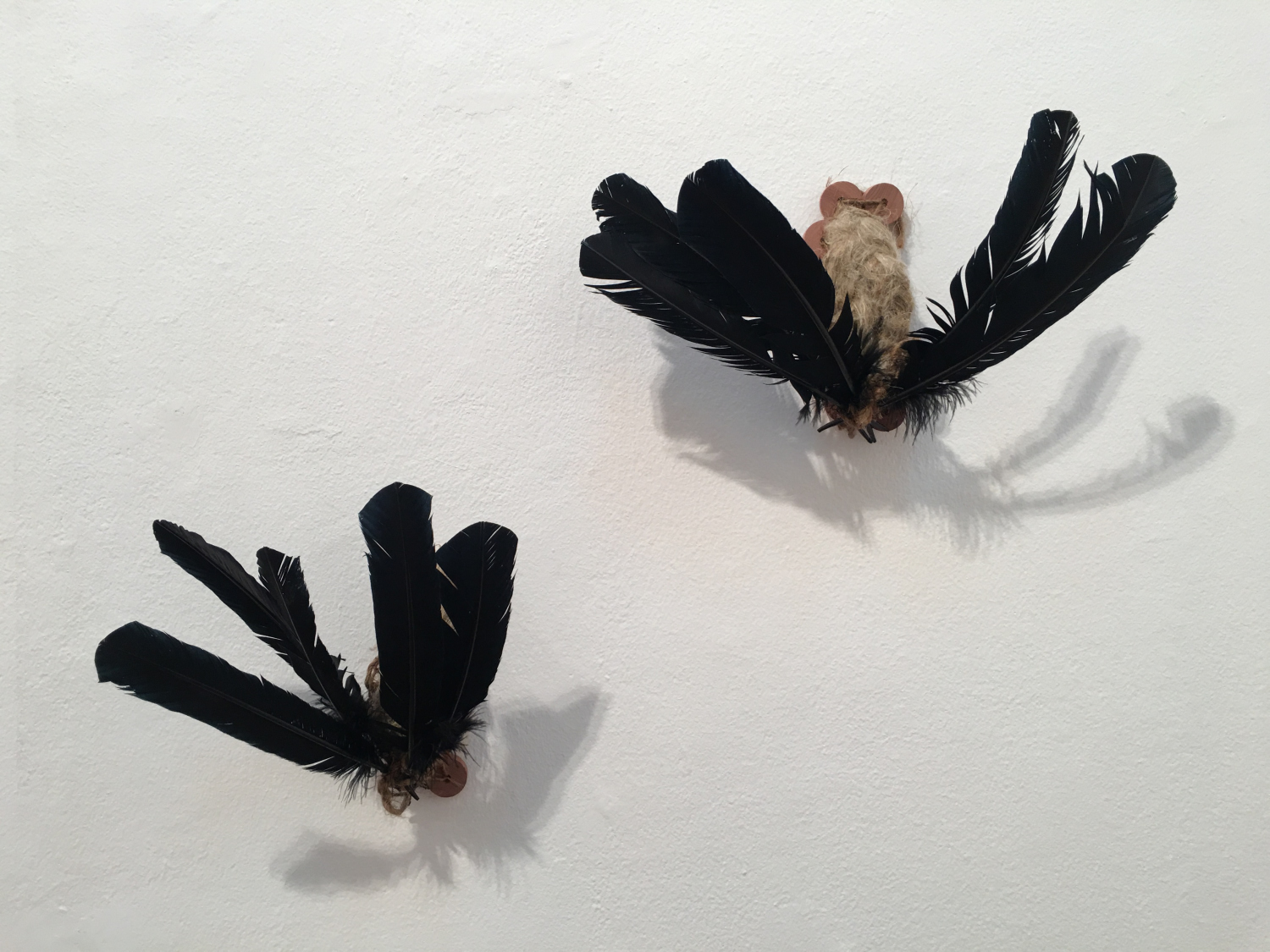
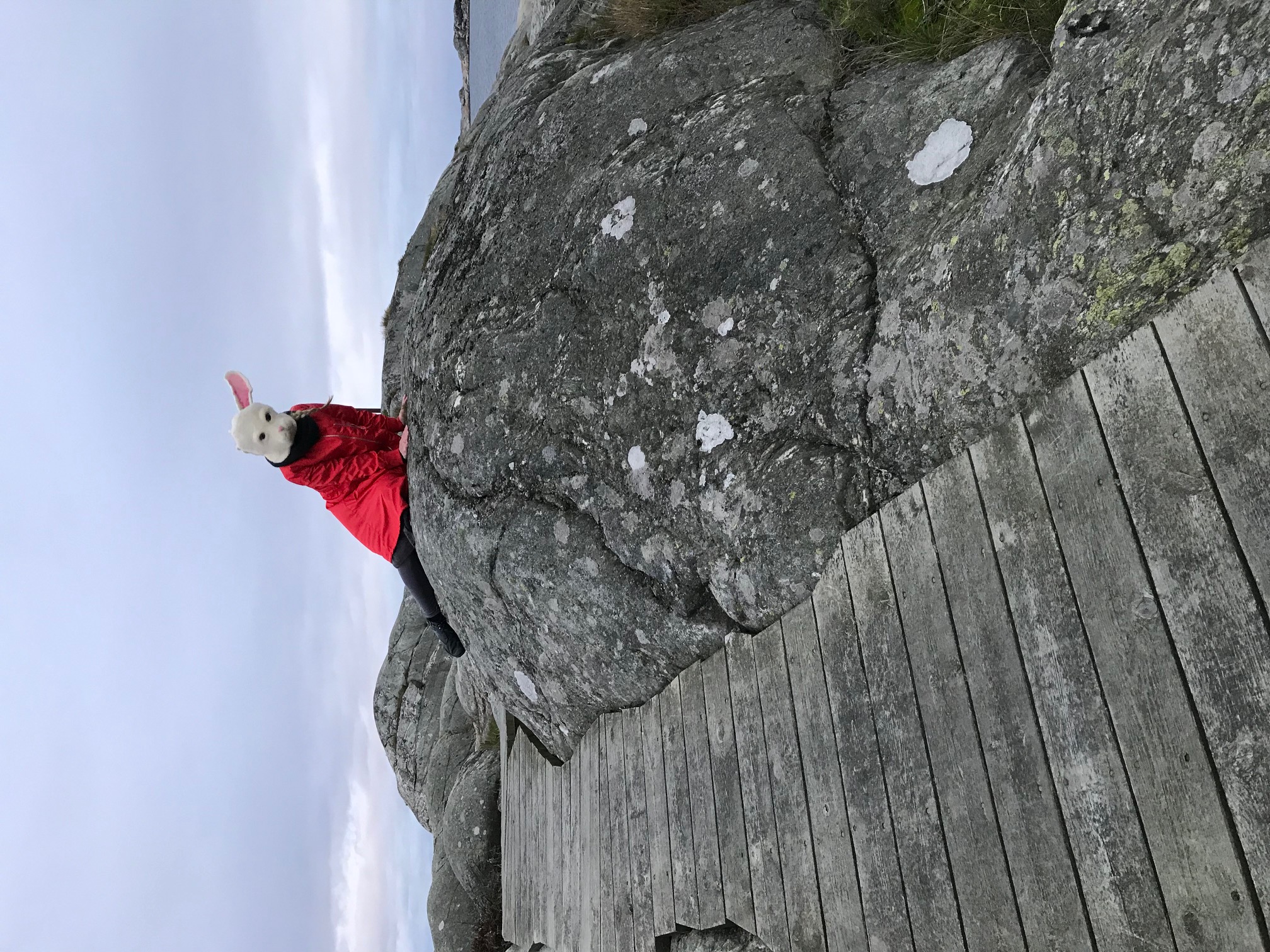
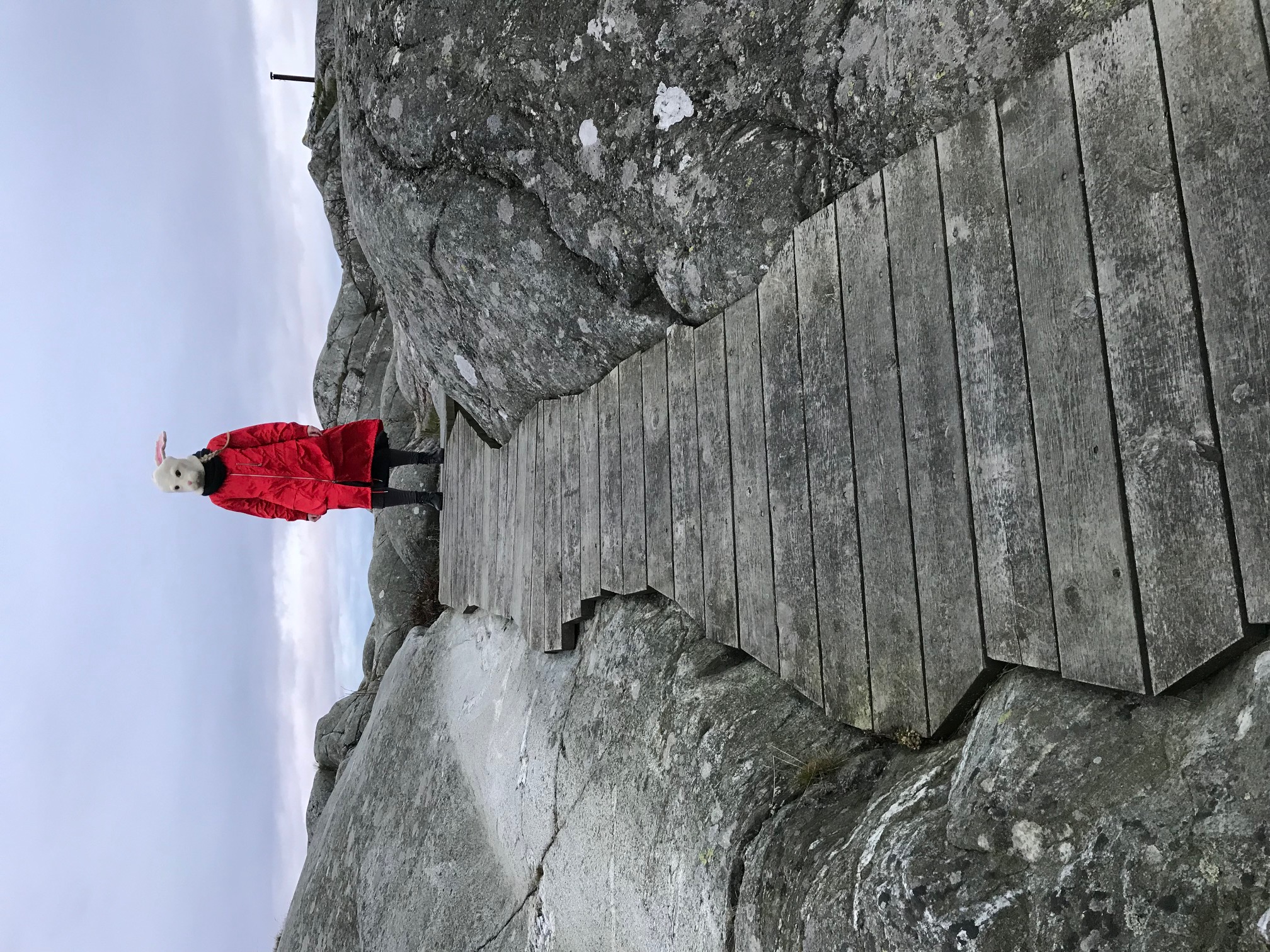
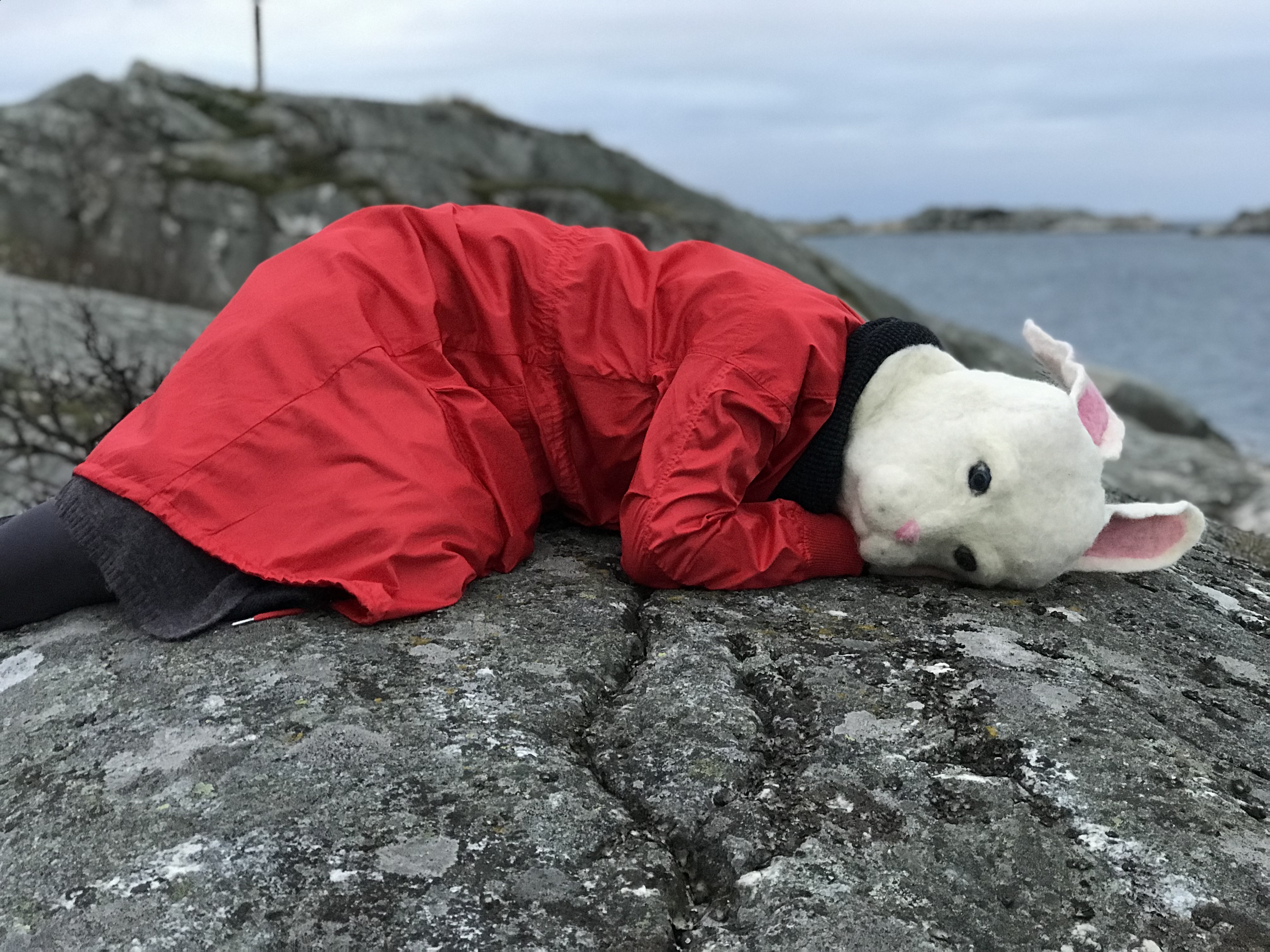
The masks I made for that exhibition — a rabbit, a deer, a raven, bird wings, a lioness in gold leaf — I had first photographed myself wearing, only as references for the drawings. But a mask is a technology for becoming something other than yourself for as long as a crossing takes, and then returning, and it wanted more than to be drawn. I knew even then that performance was waiting inside the work. The exhibition demanded I set that knowledge aside; only once the doctorate was finished could I follow it. Performance emerged from the practice the way it had been trying to, and it has continued and expanded since — the body itself becoming the place where the crossing happens.
The sea
Lately the work has gathered at the edge of the water, and this is where the next essay in this series will begin, so I will only open the door here.
For more than fifteen years, a large part of my practice has consisted of standing on a pier in Barcelona, looking straight down at the surface of the sea. I am afraid of deep water; I do not swim where I cannot see the bottom, and for as long as I can remember, I have dreamt of enormous waves and of sharks, dreams more vivid and more vast than anything the calm Mediterranean has ever shown me. So the relationship is not simple fascination. There is something unresolved in it, and the unresolved quality is precisely what keeps me returning. To stand above the thing that frightens me, attending to it closely — photographing it, painting it, year after year — is a way of approaching a threshold without being swallowed by it. In nearly every shamanic cosmology, the sea is exactly this: not water but a living being, an ancestor realm, the underworld one descends into and returns from changed. I did not plan that resemblance, but I noticed it.
That sustained attention at the water's edge is its own kind of tuning, and the sea turns out to be one of the strongest frequencies I have ever tried to receive. But that is the subject of the next essay. For now it is enough to have named the resemblance and to have suggested where, in one artist's practice, it might lead.
Gordana Zikic is an interdisciplinary artist, researcher, and curator based in Barcelona. Working across drawing, installation, performance, and painting, she explores the contemporary artist as a shaman-like figure — a mediator between worlds — grounded in her doctoral research at the Faculty of Fine Arts in Belgrade. Alongside her own artwork, she builds structures that support other artists, co-directing Belgrade Artist in Residence and Virtual Studio Groups, an international community of artists. gordanazikic.wordpress.com · @gotza_gotza