
Layered: Mark Fish on the Works of Kai Rennes
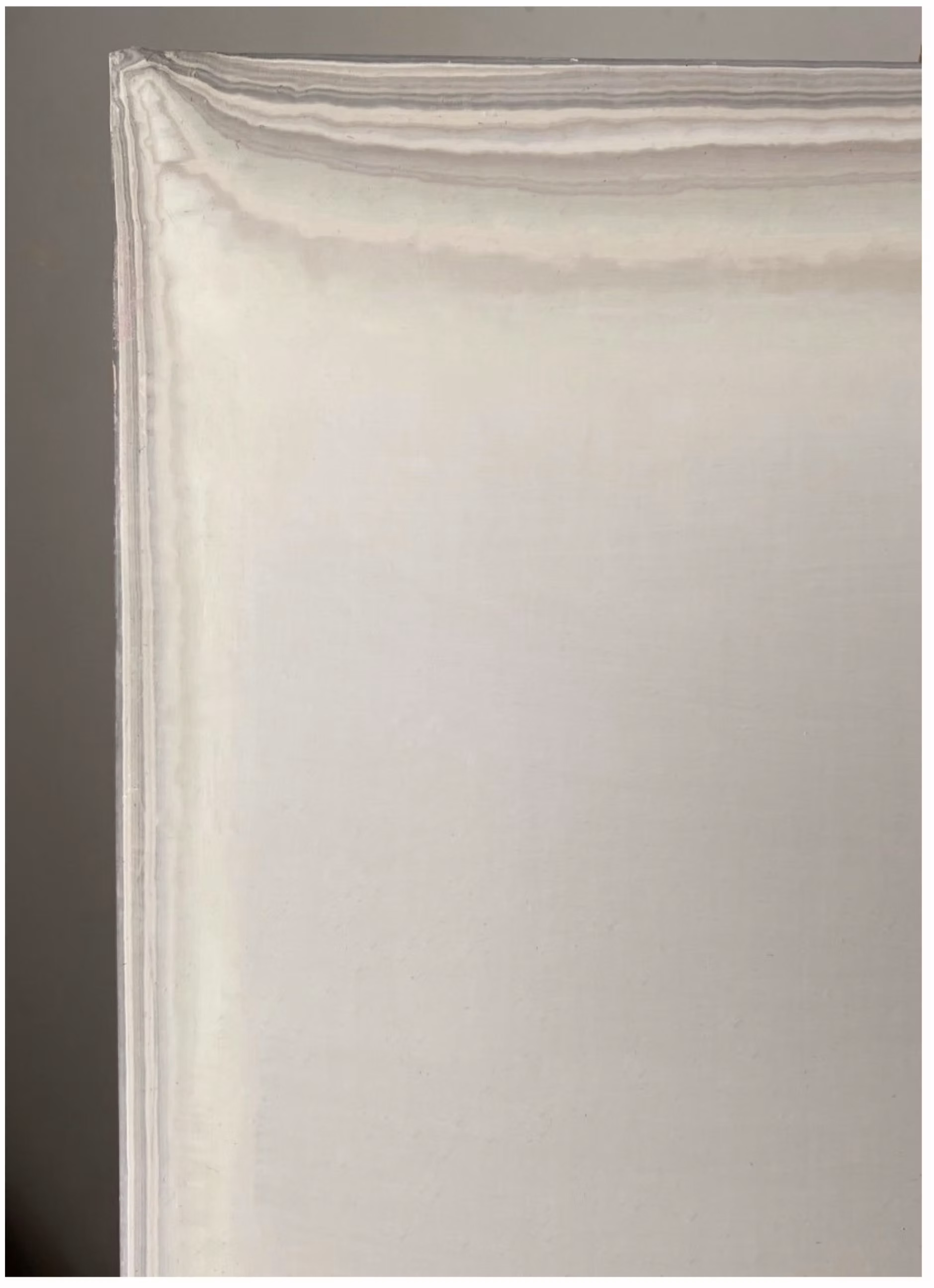
Kai Rennes, All Things Shining (detail) — hundreds of transparent layers of paint.
A series introduction from VSG Magazine
Beginning with this issue, VSG presents a series of six texts by Mark Fish, each written in response to a work by the artist Kai Rennes. We publish them one per week, and we publish them with a caution: they are not reviews, not essays about the works, not explanations of them. They are something rarer — texts written alongside the works, in their manner, at their speed. Rennes paints in hundreds of transparent layers; Fish writes in them. The texts are, in a real sense, artworks themselves: a written layer added to each piece.
A word about the signature. Mark Fish is a pen name, and we say so openly. The reader will notice that this series keeps returning to erased faces and constructed identities — men whose features are blown out by the very flash with which they photograph themselves. An author who appears only by concealing himself is performing the same gesture. The pen name is not a disguise placed over the texts; it is their first layer.
Because Fish writes inside a particular philosophical tradition, and because his sentences behave in unusual ways, we open the series with a key. Not to unlock the texts — they are not locked — but so the reader knows what kind of thinking they are watching.
A Key, Not an Explanation
Fish himself warns us, mid-sentence, against reading his texts as explanations: "Layers are not to be explained by the text! What a colossal mistake would be to think this!" What his texts do instead is something older and stranger: they add themselves to the works as one more layer. They are made the way the paintings are made. They should be read the way the paintings are looked at.
His thinking draws on Slavoj Žižek's reading of Hegel through the psychoanalyst Jacques Lacan. You do not need to have read any of the three to follow him, but three of their ideas run underneath everything here, and naming them changes how the sentences land.
The first is Lacan's three registers. For Lacan, our experience is woven from three orders that never fully overlap: the Imaginary (the world of images, of what we see and recognize), the Symbolic (the world of language, names, texts — everything that can be said), and the Real (the leftover: whatever resists both picturing and saying). When Fish writes that "the symbolic has joined the imaginary," or that "what cannot be seen can only be spoken of," he is locating the artwork precisely at the seams between these three orders. The nuance that no photograph can reproduce and no sentence can capture is his name for the Real. Art, in this view, is not a picture of the world. It is the place where what escapes both image and language becomes, briefly, present.
The second is the gaze. One of Lacan's most famous ideas is that the objects we look at, in some sense, look back at us — but without seeing. Fish returns to this constantly: the image in the mirror that "looks like it's looking, but doesn't see," the artwork that "is looking back, but doesn't see." This is not mysticism. It describes a real experience every gallery visitor knows: the uncanny sense that a work wants something from us that we cannot name. When Fish concludes, "If it is looking, but does not see, then it must be thinking," he is claiming that an artwork is not an illustration of a thought but a thought itself, happening in material, on a surface, in front of us.
The third is Hegel's appearance — via Žižek's twist. Common sense says appearances hide the true essence of things. Hegel, as Žižek reads him, says the opposite: there is nothing behind the appearance, and that nothing is the point. The secret is that there is no secret — and this is a discovery, not a disappointment. So when Fish writes of Grey Matter that the object "is a blanket and it's not, for it is the brain as well," he is not being evasive. The contradiction is the content. The same goes for his beloved reversals — "substance is the subject after all," "I am not, therefore I think." These are not errors of logic; they are Hegel's dialectic performed at sentence level, where a statement turns into its opposite and the truth is the movement between the two.
One more thing must be said about the puns, because a reader might mistake them for jokes. DASEIN. Mis(t)ery. The (w)hole. The GO(l)D bar. In the Lacanian tradition, wordplay is not decoration — it is evidence. The accidents of language, the places where one word hides inside another, are where language thinks on its own, ahead of the writer. When Fish finds "gold" inside "god" and "hole" inside "whole," he is treating words the way Rennes treats paint: as material with its own depths, its own layers, its own nuances that cannot be paraphrased. The pun is a layered surface made of letters.
So, how to read these texts? Slowly, and without the ambition of full understanding. They will contradict themselves; let them. They will assert something impossible and continue as if it were obvious; follow anyway. Fish offers his own permission slip: "Being confused is all too easy, what is not easy is being confused." Confusion, held properly, is not a failure of reading. It is the state these texts are written from and written toward — the same state in which one stands before a painting whose hundreds of layers can be sensed but never counted.
The texts fail at common sense. So does art. That, Fish would insist, is not their weakness but their definition.
The Six Texts, Briefly
For the reader who wants firmer ground before entering, here is what each text circles around. Consider these notes a map drawn from outside; the territory behaves differently.
The Nuance that cannot be seen — DASEIN (on All Things Shining). The paintings hold hundreds of layers that can be sensed but never seen one by one — time itself sedimented on the surface, like geological strata. What escapes the eye can only be spoken, so the text becomes a necessary layer of the work; yet it does not explain the image — it marks the point where the image exceeds seeing. The central claim: art is not a metaphor for thought. The artwork itself thinks, and what we see, when we truly look, is thinking made material.
(Grey) Matter. We look at washi paper and see a brain. Common sense says the appearance hides the real thing; Fish, following Hegel, says the opposite — there is nothing behind the appearance, and the gap between "it is paper" and "it is a brain" is the work itself. Identity works the same way: a "solid" thing is the hologram of all its appearances stacked together. Things become what they are through what they are not.
Discourse of the Artist. The artist's true invention is not the image but the surface — a place where "nothing" can appear. Before the first cave drawing, the wall was only a wall; after it, it becomes a place where something stands where nothing was. That gesture — putting a mark where nothing was — is the birth of meaning itself, and the artist is the first to address others this way: art as the primal form of communication, before language.
"Andromeda?" Men photograph themselves in mirrors and the camera flash erases their faces — the very act of showing oneself destroys identity. Rennes collages these overexposed non-faces into a galaxy: what is lost in every detail (the individual) returns as pattern (the whole). An artwork, Fish writes, is an answer to a question we don't know; it does not ask, it states — look, it is I who is asking.
The GO(l)D bar. The Apple logo is one bite short of a whole apple — and that missing bite is exactly what makes it desirable: desire organizes itself around a lack. Gold stays gold in any shape, God stays God even in a man, the iThing stays whole even bitten — substance survives every form. The text's final movement, via Dave Chappelle and Žižek, pushes further: we only ever receive the partial thing through the hole in the wall, and we fantasize the whole behind it. That is desire, and that is the commodity.
The Reddish Eye. An inversion of Descartes. "I think, therefore I am" becomes: the eye looks, but I cannot verify that it truly sees — so where I see, I cannot be sure that I am. "I am not, therefore I think": thinking begins exactly where being fails. The red-eye photo glitch is the perfect image for this — the camera's error shows us the eye as a thing, and the moment we see the seeing apparatus itself, the seamless "I" breaks. An appended note by the curator Zolt Kosma adds the second theme: art, like evolution, is born from error.
Across all six, one movement repeats: something is always missing — the nuance, the face, the bite, the essence behind the appearance — and that missing piece is not a defect. It is the engine. Art, in these texts, is the practice of making the lack visible.
Part I of a six-part series. Read Part II: The Nuance That Cannot Be Seen — DASEIN.